There’s No Such Thing As Being Behind.

I’ve been a little absent from social media of late. My family got visited by everyone’s favourite spicy flu (as my friend Rachael would call it) and I decided to keep everything simple while we navigated our way through that.

As always, when your usual schedule goes a little wonky, things, well… came up. There are always logistical things to take care of ranging from the practical (work, feeding animals, taking care of other people who are feeling poorly when you aren’t feeling that flash yourself) to the slightly more “meta” observations of how attached you are to things running a certain way.

Historically, for me, one of the biggest frustrations (and even anxieties) that I experienced was when my tightly designed schedule blew up in my face. My circumstance is not unusual in that I have many balls in the air at the same time- my own business, two young children, five horses to work and handle- which I share not for sympathy (I chose and continue to choose all of them) but because in order to keep things rolling in the way that I like, I’ve always had a pretty solid idea of what was happening when.

That is, until the last couple of years where things started to change. You may have heard me talk before about the essence of my work with the nervous system being about creating adaptability and accurate responsiveness. What that means is that there is no one nervous system state that is good or bad; it’s just, it is appropriate for the moment?

What we are looking for is our nervous system to sense into what is going on around us and to respond in a way that matches the experience. For many of us- those who perhaps feel they are stuck in a ground hog day loop, or who have trouble moving on from a particular moment in time- that adaptability and responsiveness is no longer there.

My need to have things roll out in a particular way- for everything around me to follow my ideas about what should happen when- is an example of a control pattern. When my experience matches my control pattern, I “feel” good. When they don’t, however, I don’t. And let’s face it, how often is life following the plan that we’ve laid out.

Consequently, I left myself open to an ever-fluctuating experience of struggle from attempting to control the uncontrollable; time and my experience of it.

I’ve also come to realise how prevalent this is for many people out there, and it feeds into our ideas of time not only following a straight line, but progress following a straight line also.

Here’s another example for you:

Recently, I started an add-on option in my membership called the Jumpstart. Basically, you tell me what’s up and I make a program for you of the movement practices and things to practice over the course of the month. A bit more intensive support. As I read through people’s forms, what comes up time and time again is this idea of “falling off the bandwagon” and having to start again; the perpetual feeling of not being able to “keep up” and of being “behind”.

I use quotation marks around these words for specific reason, and that is, the feeling that motivates them is one that we have completely made up. It’s not real.

You can only be behind if 1. You are following a linear path and 2. You have an expectation of where it is you’re supposed to be. And if this is the mindset you are operating from, you are always going to feel like you’re on the hamster loop.

What IS real is finding what’s possible in this moment and doing it. What IS real is not seeing time and a long road laid out behind you and before you but in the series of separate moments, each to be treated and experienced differently to the next.

So, what does this look like in practical terms?

Well, take two of my horses, Dee and Merc. Both of them I aim to ride 6 days a week. The past version of me would have felt anxious, cross, and upset when for some reason this wasn’t able to happen (like with the spicy flu). I would have been momentously grumpy about that and allowed it to colour everything else about my day.

I most definitely would have felt “behind”. I most definitely would have felt like I had “fallen off the bandwagon”.

I wasn’t adaptable. I was fixed.

In my latest experience, I recognized what was possible and what wasn’t in that moment. Instead of feeling behind, I picked the rope and the reins back up when I was able and, well, started working with the horse that I had. This was a different moment and different things were possible within it.

So what I offer you, fabulous human wot has almost read all the way to the bottom, is that if you are reading this and identify with what I have written, understand that feeling frustrated about things not going the way we planned trace back to our need to control.

And if we can reconcile that- if we can instead meet the moment and ask ourselves what’s possible now- we can begin to release our stranglehold on our ideas around time and our attachment to exactly how it’s supposed to be used. And we can see how much of our suffering is, in fact, self-created. Oof.

Adaptability. Meeting the moment. Taking action on what’s possible.

Onwards.

❤️ Jane

Making Friends with Forward: A Three Part Workshop

I’ve been musing over this post for a while now, the reason being that what I’m about to talk about is not black and white. And I think that’s the point. Working with horses is nuanced. There is no linear formula, and there is no set process that suits any one horse, beyond a set of common principles.

It’s our role then, as riders, to seek balance. The possibilities for our horses in movement exist only within the range that they are balanced. Our job as riders, then, is not only to facilitate that balance so they can carry us without compromise (physically, emotionally and spiritually), but also to ensure that we ourselves are not the reason that the seeking of balance is not possible- which is more often than not the case.

For many years now, I have been a student of horsemanship and have ventured down many rabbit holes in the quest for harmonious partnership. I am also fortunate to have many different types of horses in my horsey family, which allows me the luxury of working with horses of varying dispositions, gymnastic capability and personality. Over the years, I have come to realise some of the mistakes I have made and the challenges that I’ve had, and for the purposes of this conversation, it has to do with the relationship to the use of the reins and contact.

Many of the horsemanship circles that I’ve moved in all hold fast to the principle of riding on the buckle. That we need to let the head and neck “go” to allow for free and forward movement. That riding on a loose rein at walk, trot and canter is the foundation of everything that comes after.

This is where things get sticky. I don’t completely agree anymore.

Here are some things I add as a disclaimer that somewhat complicate the discussion:

  1. When we ride to control rather than harmonise

Many riders struggle with their own balance in the saddle to the point where contact with the reins becomes yet another form of control. If our own bodies resist the dynamic movement of the horse- physically or emotionally- then it’s impossible to have a discussion about contact and balance that’s useful.

In this case, I agree- let the reins go.

Conversations that involve contact must originate from the body of a rider who has enough organisation to adapt to what the horse is offering and respond accordingly. If not, then we begin with the rider, not the horse.

  1. We don’t have a clear understanding of what the bit means

If we were to ask a group of riders to explain what the function of the bit is, how many do you think would be able to clearly answer? And if the rider’s themselves don’t know, what hope do we have of communicating anything of value to our horses?

Confusion creates conflict. Clarity promotes understanding.

If we aren’t clear on the primary function of the bit creating relaxation of the jaw, then what are we using the bit for?

Control.

And if that’s the case, again, I agree. Let the reins go.

  1. Our horses aren’t taught a healthy relationship to contact. And nor are we.

If contact has been about control rather than a conversation about balance, then it’s always going to promote aversive feelings.

If it’s about balance, then we can allow our conversation with contact to create a better feeling in the body, a greater movement towards harmony. In this case, contact is responsive and adaptive. It’s fluid, not fixed. And it starts with us out of the saddle, not in it.

***

This is by no means an exhaustive list, but it provides a good start point.

This whole conversation came about when I realized how many riders I work with have an anxious relationship with “forward”. There is either a point where they shut the forward down, or where they prevent it from happening altogether.

Some people can identify specific moments when the “forward” becomes a worry for them. For instance, when the trot gets bigger or when canter enters the equation.

A conversation on making friends with forward, however, not only needs to include the biomechanics and mindset of the rider, but also the balance and mechanics of the horse. And in order to truly understand the balance of the horse, we have to further understand our relationship to contact and how it affects our horse’s balance and ability to find relaxation under saddle.

Making Friends With Forward is a 3 part series that I’m holding in my membership program, JoyRide, in which I explore the various aspects of forward and share some of the mistakes I have made with my own horses along the way that have impeded our quest for relaxation under saddle.

Part One is a Tale of Two Horses: Dee, a 17.1hh warmblood/ sport horse, and Merc, a 15.3hh paint crossbred. Two very different horses, physically, mentally and emotionally. In both instances, redefining our relationship with the contact and balancing the front end has been a total game changer- both for very different reasons but with equally powerful results.

In Part Two, the fabulous Kate Sandel from Soft and Sound is coming to talk with us about the finer aspects of balance as it relates to forward and relaxation under saddle. Kate teaches in line with the French classical school of Legerete and the Vaquero horsemanship traditions.

And in Part Three, I’ll be discussing our concerns and anxieties with forward from the perspective of the nervous system and giving practical tools to remedy the blocks and challenges you may have.

You’ll have access to all these live trainings and recordings as a JoyRide member.

If you want to join me for Making Friends With Forward, it’s part of a workshop series we are holding in my membership program, JoyRide. You can check it out or come join me here 💃

❤️ Jane


Are You Creating Your Own Fight Flight Reflex?

Last week, I wrote about my experience with frustration and how the whole “leave your emotions at the gate” is not mantra that I subscribe to. As you know, our emotional life can create some enormous highs, some fairly long plateaus of not-much-ness and some equally deep lows, and it can be confronting to consider how much we ourselves are responsible for those experiences.

The conversation of emotions is a big one, so for this one I want to zero in on our physical relationship with emotion and how our interpretations of what’s going on can pull us into a fight flight response.

The structure of our body is changing all the time. Between the parasympathetic and fight flight nervous system, our bones and organs all change their position. Even at rest, we are not static creatures; our system is humming, changing, moving pulsing.

Our brain is making ongoing decisions about our safety in relationship to our environment and our structure is responding accordingly. We experience sensation when the structure of our body changes in response to sensory stimulus. In this way, we are designed to be getting messages from our body all day long.

For example, I can feel a tightness in my chest, even a shortness of breath when my diaphragm moves up in my torso, shifting my heart and lungs from lower down to higher up.

In reality, this is a movement towards the parasympathetic; in the sympathetic system, my diaphragm drops, and my heart and lungs follow suit. The reversal of this position indicates my system is returning to more “everyday operation” mode.

Where things start to go wonky is when I start to interpret physical sensation and meaning with a specific emotional label. If we continue to run with the example I’ve given above, many people interpret that experience in their body (tightness in the chest, shortness of breath) as anxiety.

When we habitually attach an emotional label to a physical sensation or experience, we “map” that experience into our brain, and tie the two together as a sympathetic reflex. What that means is that every time I then experience a fullness or tightness in the chest, I create the experience of “I am anxious”.

As every thought has its own motor pattern, the experience of anxiety expresses through me, regardless or not it matches the reality of the moment.

Just because I’ve attached the label of anxiety to the physical sensation, however, does not mean my interpretation is accurate. Instead, I have come to interpret a particular experience in my body as dangerous or negative when in fact, it was the body shifting OUT of fight flight mode.

Decoupling emotional labels from physical sensations and associations is a big part of my work- and one that can literally be life changing. We get ourselves in so much trouble with our subjective interpretations of what our body is communicating to us, and in doing so constantly pulls ourselves into the sympathetic.

We are meaning making machines, so we have a responsibility to ensure we aren’t making life more difficult than it needs to be.

Onwards.

❤️ Jane

If you are interested in doing this work together, check out JoyRide. This is a big part of what we do. You can check it out here! 


So you’re frustrated….

On Tuesday, I caught Merc and brought him into the yards with the plan of going down to the arena and working together. By the time we had made it from his paddock to the tie up space, I knew something was off. He was as high as a kite and somewhat fancied himself as the paint version of Spirit, Stallion of The Cimarron. His posture was high and tense. He was reactive and jumpy. All very un-Merc like things to be.

I knew instantly what it was all about. Over the last 24 hours, I’d grazed him on a short, relatively eaten out paddock while I got things ready to shift the horses around for their winter grazing, but there must have been enough of the rocket-fueled sweet green stuff for him to decide this was the beginning of his tap-dancing career. I abandoned my plans to ride and instead thought we would head down and do some in hand work instead.

The beginning of our session started predictably, and such is Merc’s heart and mind that even when he’s juiced up he does his best to figure out what I’m asking of him. Then our neighbour walked up the road with her horse and for a few moments, he forgot all about me, puffing himself up and out in all directions.

In that moment, I had an interesting experience. I felt myself become something which I would label as frustration, and I clearly witnessed the course it took through my body.

But instead of buying into it; instead of investing in the frustration, holding hands and taking off together, my mind said to me, it doesn’t matter that you’re frustrated. So be frustrated! But remember, being frustrated is not a get out of jail free card.

You can be frustrated and still pay attention to what’s in front of you.

You can be frustrated but you still need to make a decision based on what your horse is showing you and move from that place.

I find it hard to articulate what a powerful moment this was for me. The experience of an emotion is defined as a physiological event in the body, followed by a subjective interpretation. That’s it. What gets us into trouble is not, then, the experience of the emotion itself, but the meaning that we attach to it, and our habit of being unrelentingly focused on a fixed outcome that is mismatched to the experience we’re actually having.

We hear a lot about leaving our emotions at the gate or separating emotions from experience. All of which leave you trying to be something that you’re not. Great in theory (or is it?) but impossible in practice.

So, while we can’t leave our emotions at the gate, what we can leave is our labels and our stories about what they mean.  We can allow our bodies to have the physiological experience of the emotion without grabbing onto it and falling down the rabbit hole.

I’ll write tomorrow about how we can “map in” emotions and sensations, and how that leads us into a sympathetic spiral, but for the moment, it’s interesting to note:

My frustration coursed through my body in less than 60 seconds. It came, passed through, and left without leaving a residue or an imprint. It was fleeting. A blip.

Not defining. Not overpowering. Not immobilising.

Just a physiological experience that passed through, and on its travels, caught my attention.

Onwards.

❤️ Jane


Looking At The Need To Control

Survival patterns are patterns that we have learned and developed in childhood as a means to get our needs met. They can and do take many different forms.

For instance, perfectionism is a survival pattern.

The need to control is a survival pattern.

The need to be liked is a survival pattern.

These patterns shape our behaviour and the way we navigate our life as adults. They are the gnarly, murky parts of ourselves that are hard to look in the eye because they don’t represent the best of us.

In our Q&A session this week, we had an interesting discussion around control. What if control, it was asked, has been our friend? What if it’s the way that we made our way through? How do we know if it’s the “good” type of control or the type of control that is getting in our way, stopping us moving forward and keeping us stuck in one spot?

My answer was this:

It’s important to differentiate between what control looks like and what consistent decision making and action taking looks like.

If I am looking to control something, what I’m essentially saying is:

“The decisions and actions I’m making now are motivated by the desire to control my reactions and experiences in the future”

In other words, I shape what I do now (or don’t do now) as a means to avoid something negative that I perceive may happen (or as a means to “force” something I want to happen). I’m not motivated by present moment reality but by future expectation.

I can, of course, make decisions and take actions that sit outside the paradigm of control.

In this way, we are saying:

“I’m observing something in my present experience (that I may wish to change) and I’m making a decision and taking an action towards something different based on that knowledge.”

Here, I hold a possibility of something more, but I’m not basing my actions on any attempts to control the future.

We seek to control because the truth of where we are or what we are being shown is not always easy. It’s not always roses and butterflies.

But there’s something beautiful about claiming where you currently stand, however messy that may feel. In that space, you can hold positive possibility for the future without seeking to control it. They are two different things.

It’s an exercise in self-trust. And at the end of the day, trusting that we can and will handle whatever comes our way is the only true control we really have.

Onwards.

❤️ Jane

We look at survival and behavioural patterns in Joyride- both understanding more about them and learning how to navigate through. You can learn more or come join us here!


Noticing Changes In Reverse: A Story From Out On The Trail With Dee

I got asked in a podcast interview once who was the horse that has influenced me the most, and the answer was Dee. The reason for this was this Dee is the first horse that I have really done everything myself with. He has taught me so much not only from a horsemanship perspective, but also about myself. I’ve often joked that I am competing in the “Longest Road to The Horse” (a play on the three day starting process demonstrated in the Road To The Horse competition), and when I had a couple of people approach me about starting their horse’s for them, I told them that was fine, if they were happy to pick them up in three years’ time. For me, the slow way is the fast way.

Despite not taking Dee out on the trail until his basics were well established, he toes would always twinkle, his eyes would be bright and wide, and his big, long neck stretched out like a honing beacon looking at everything around him. He has a quick spook and if he’s unsure about something, it reverberates through his entire being.

Consequently, for a good while there, taking Dee out was not my favourite thing. I understood it as an important part of his life and experiences, but I talked myself through the entire experience. I got off as much as I got on. I don’t see the point in putting yourself in a position that does neither you nor your horse a disservice.

Then, a thing happened. Dee has a couple of months off with an injury and I knew that in order to get him fit and strong again without straining his body, the best thing for him would be lots of hacking out. I made a program that involved warming up by riding round the farm before we schooled in the arena, an order of operating that I had never done before. The hacking always came after- after we had a conversation going and we had worked in together.

I noticed myself narrating my experience as I flung my leg over and got into the saddle. My husband had been fencing and there were tools lying either side of the track we were riding on. Dee grew an extra hand as we rode down the track, eyes googling at each thing on either side.

Huh, I said to myself, I don’t feel concerned at all. I talked to him, stroked his neck, gave him a moment, asked him to keep on going.

All the way round, things popped up. The neighbour’s dog bounded over. The chainsaws on the boundary fence tidying the trees. The crackling of the wind. Dee noticed it all, responded to it all. And I noticed him. But my body felt different.

Where I would have got off, I stayed on. I felt assured and confident we had what we needed to manage.

Where I perhaps would have turned around, I continued on.

And I attribute all this to the movement work I teach in JoyRide. I’m often having conversations with members saying you will notice that your nervous system has changed retrospectively. That you do something where in the past you would have had a predictable set of responses and you notice after you’ve done “the thing” that you were different. That something is different.

When you “clean house” of your fight flight patterns that are no longer serving you, this is the effect. Moving through challenges does not become so much of a conscious conversation, an effort of will. It’s a slow, background change that’s shifting the landscape you rest on until all of the sudden, something is different.

You are different.

My experience of riding out with Dee the last few months has been different. And I can truly say it’s become a joy instead of a job.

Onwards.

❤️ Jane

Click here if you want to learn more about JoyRide, or want to join! 


The Best Position Is The One The Harmonises With Your Horse: A Discussion On Rider Biomechanics

In my membership group yesterday, we began a discussion on biomechanics, and I was asked my opinion on some of the more well-known forms biomechanics training and teaching available to riders. Instead of launching into a critique, however, I thought it would be useful to highlight what I understand to be different about the form of biomechanics that I offer.

The subject of biomechanics is a vast and interesting one. In relation to the teachers mentioned in my group, I have dabbled in the respective fields that are mentioned, but not to the extent where I feel like I have any sort of authority to comment as the specifics of how those instructors or teachers present their work. I feel it would be like someone looking at what I teach briefly and then casting judgments based on those understandings. I would find that frustrating and perhaps a little insulting.

That said, many people plant their flag in the sand when it comes to this subject. If we have spent years honing our bodies in a particular direction, it’s a big deal to recognize that perhaps things can be done differently. The understandings of the body and brain are in such a process of evolution that one would expect some facets of our understanding around our body and position to be discarded and updated, but yet we hang on and are challenged to the point of defensiveness when other concepts are introduced- even before we perhaps understand them ourselves.

With that in mind, these are the underpinning principles of what I teach.

  1. WE HAVE A VERY CLEAR SEPARATION AND UNDERSTANDING OF THE ROLE OF THE CONSCIOUS AND UNCONSCIOUS BRAIN

We understand that the autonomic nervous system, and specifically the reticular activating system oversees our motor responses, and consequently, the structure of our body at any one moment in time.

Where our structure reflects parasympathetic or unconscious processes is based on the answer to the question:

Are we safe?

The unconscious brain decides this based on sensory input.

When we have been living more in our sympathetic system than not, our sensory nervous system goes offline, and consequently, our structure and biomechanics are reflective of the sympathetic.

Our work here is about rehabituating the sensory nervous system so that we are more adaptable and responsive, and our body can exist in a structural mode that does not compromise one part of the system over another.

Many traditional biomechanics programs pay rudimentary attention to the nervous system but only to the extent of “if you are nervous, you grab with the reins/ close your front body/ round your shoulders”. In other words, they identify the fight/flight reactions, but the response is to remedy this by manipulating the tube of the body (ie. Conscious postural correction or otherwise), which leads me to the next point…

  1. WE DO NOT CONSIDER IT THE ROLE OF THE CONSCIOUS BRAIN TO CONTROL THE BODY

This is perhaps the most fundamental difference.

Instead, I understand the role of the conscious brain to be:

– Decision making (creating the intention map for the movement)

– Action taking (taking the action without controlling how the action is taken)

– Observation (sensory feedback)

Its role is not to control HOW that action is taken. Instead, the unconscious brain makes constant assessments based on how far the action we took existed from our intention, and seeks to make the motor pattern more efficient and proficient with every future action we take.

For some, this will be a point of liberation and for some, they want to stay with the conscious control model. This work is not going to be for everyone if for nothing else in that… it’s all on you. It’s not a quick fix.

I haven’t found many (any!) forms of riding instruction that does not involve some form of conscious manipulation. From the point of view of this program, to consciously manipulate the outer form of the body only results in a change in outer appearance, and not inner mechanics. If it hasn’t been the decision of the brain to change how the body is arranged, then changing the body forcibly will only result in continued compromise and compression of the structure.

If conscious manipulation and change of the structure created true harmony and wellness, then the overall affect should be more harmony and wellness- in and out of the saddle. Your mental outlook, ease of movement and general wellbeing should be improved, and yet we rarely see these correlations.

  1. WE CONSIDER AND UNDERSTAND THE DIFFERENCE IN HOW THE BODY EXPRESSES STRUCTURALLY BETWEEN THE PARASYMPATHETIC AND SYMPATHETIC NERVOUS SYSTEM

There is little to no mainstream understanding of the structural changes that occur in the body between sympathetic and parasympathetic.

The majority of the population is so sympathetically dominant that we have normalized this as the way of being. Without this understanding, the only thing we can offer is to take how the body is presenting from an aesthetic point of view and correct it from the perspective of outer appearance.

What I hope to offer here is the understanding that there is a whole range of possibility for our structure and position that sits outside the normal paradigm and to my mind this holds the key to a greater sense of harmony and wellness.

  1. WE DON’T CONFORM TO ANY AESTHETIC RULES

The main ethos of what I teach from the point of view of biomechanics is that the best position you can take is the one that harmonises with your horse. This is also formulated from the understanding that if we have a fixed outcome or goal as a result of taking an action, we eliminate all possibilities for the brain to learn.

  1. WE ARE HOLISTIC IN OUR FOCUS

We are interested in the interrelationship of all parts of the body in movement, as opposed to just muscles and bones. For instance, fascia and organs are rarely mentioned in many circles and yet are foundational considerations.

I hope that goes some way to clarifying. More than happy to answer any questions or continue on with the conversation.

❤️ Jane

If you want to learn more about JoyRide, or come and join us, click here!


Trauma As A Dominant Pattern

Modern living has got us into all sorts of pickles when it comes to our nervous system. Let’s consider movement as an example. In early human times, movement was not something you chose. It was part of how you survived. You required movement to get your basic needs met; to hunt and gather, to take care of those around you, to build and maintain shelter.

In modern, first world countries, however, movement is now something we choose- or don’t choose. It’s something we do or don’t do, as part of a conscious exercise program that ranks in varying degrees of importance depending on our priorities and tendencies. For instance, I can literally never leave my house and have all of my survival needs met.

I can order food online. I can call people to mend my house if it needs it. I can chat to people on my phone. If I so choose, I can stay put in one room and be ok. I might not be happy, but all my most basic needs can be met.

So how does this relate to trauma? Well, it relates a whole lot. In fact, it’s fundamental. And for the record, I rarely, if ever, use the word trauma in my life and work anymore, but I do so here for the simple reason that it gives us a common playing field to work on, and for the sake of this discussion, that’s important.

If you are playing along with me at this point, I want you to start to consider all of your experiences in terms of patterns. If I have an experience that I might label or consider traumatic, I have now created a pattern related to that experience. This pattern can be a combination of both a physiological reflex (so a structural change and movement expression in my body) and a thought pattern and they can manifest in many different ways.

If we zoom out for a moment and consider the brain more generally, it is a storehouse for a huge number of movement and thought patterns. The ones that we practice the most are our dominant patterns. A pattern becomes dominant if it goes unchallenged. Challenge to a dominant pattern occurs via our senses, with the brain continuing to upload sensory data to ensure that what we are expressing and experiencing is a result of what actually happening, rather than something that happened in the past.

So let’s say something happens to me that really shakes the ground underneath me, something that I might label as trauma.

In the first example, I would not have the option to make my world smaller. Whether I liked it or not, I would have to be in life. I would have to move to get my food. I would more than likely have people to take care of. I would have to be in life. Because if I wasn’t, I wouldn’t survive.

As a consequence of being in life, I’m constantly uploading sensory data to my brain. I’m moving my body, expressing different patterns and creating new ones. The pattern around the trauma may still be there but it does not go unchallenged. And the more novel movement I do, the more engaged I am with other people, with activities, with my environment and with life, the more contextualized my trauma becomes. It sits in the content of the past rather than becoming an experience I constantly relive in the present.

Flip to the more “modern” option, and we have lives and upbringings where movement, play and exercise are often seen as luxury add ons when we have the energy for them. It’s a choice for adults, and for children these days, needs to be facilitated. Those for whom movement exists as a part of life and their everyday routine is in the shrinking minority.

So in this instance, if we have a situation where something happens to us that we experience and label as traumatic, from a physiological perspective, the pattern can easily go unchallenged. Our world gets smaller, we move less, do less, and the brain has limited opportunities to take in new information and create new patterns that provide buffering, understanding and context.

Instead of the trauma being part of our experience, we are now our trauma. It sits at the forefront of the brain in all its unchallenged glory occupying our thoughts and physiological expressions.

I write this not to minimize anyone’s experience but to highlight the reality of the essentialness of movement- and novel movement at that- in shifting experiences of trauma and creating a new reality; one that matches where you are now, not where you were previously.

We are creatures of movement. We move and shape our reality as we go.

Onwards.

❤️ Jane

Co-ordinating With The Balance Point Of Your Horse: The Nervous System In Movement

We’ve been working through a movement arc series in JoyRide that explores the difference in how the body moves between the parasympathetic and sympathetic nervous systems, and how it is we can create intention maps for movement that allow us to best harmonise with our horses when we are riding.

The possibilities for your horse in movement exist only within the range that he is balanced; our job as riders, then, is not only to facilitate balance in them in order that they can carry us without compromising themselves, and to ensure that our balance point matches theirs.

The balance point at any one moment in time is related to your centreline, and finding the balance together involves understanding where and how your horse’s centreline moves in space so you can coordinate together in movement. This is what the essence of the movement arcs revolve around.

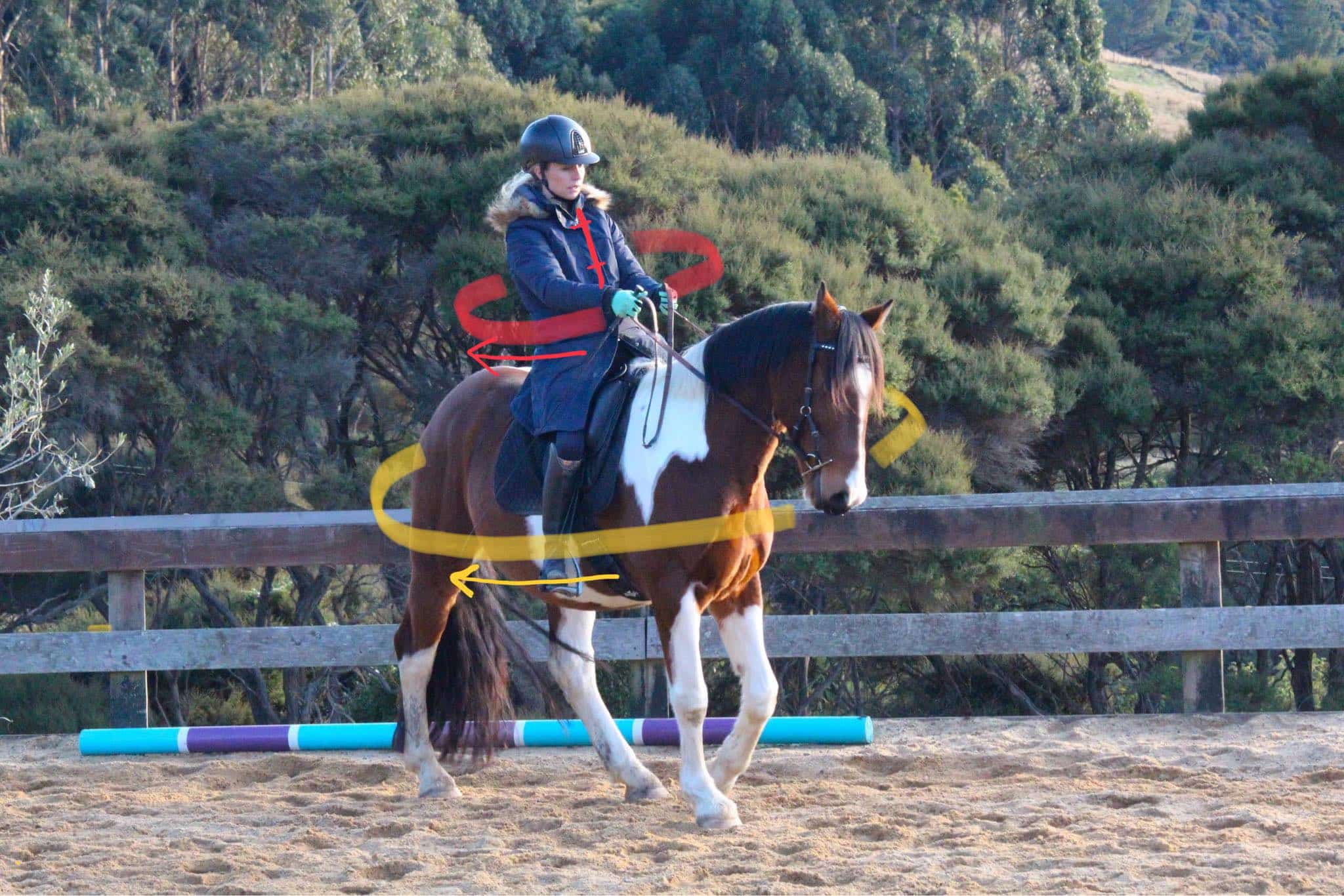
This is a photo of Merc doing a movement called a neck rein turn, which is something you see often in the school of Legerete. Here, the flexion is to the left, but the direction of travel is moving right, with Mercs head and tail moving on the same line, within the same arc, like a dial turning.

The position of the head and tail informs which arc we choose to shift the centreline on, and in this particular instance, my intention is to shift the centreline on the transverse plane in a best effort to sync up with Merc’s balance point.

In the movement and riding practices I teach, we work to the principle that the structure of the body and how it organizes itself in movement is the domain of the autonomic nervous system and thus outside of our conscious control.

What is in our conscious control, however, is the intention we have for the movement, the taking of the action, and the observation of that action.

So as I perform a movement with my horse I have:


  • Clarity on the movement pathway I want my body to take
  • I create the intention for the movement
  • I allow the movement to happen (again, without controlling HOW the body does the movement)
  • I observe how far away the outcome was from my intention


This process is the essence of how the brain learns; a process of endless action, observation and course correction that is an alchemy of conscious and unconscious processes.

In this way then, every movement is a success. As long as I am clear on what I am trying to create, I cannot control the outcome. I can only allow myself and my horse to explore the process with the understanding that our efficiency and proficiency will increase as our brain draws us our intentions and our outcomes closer and closer together.

An endless adventure of curiosity.

Onwards.

❤️ Jane

In JoyRide we are actively exploring the Movement Arc practices that allow for greater harmony and ease in the saddle (and get you out of the fight/flight reflex patterns so many of us are stuck in!). Click here if you want to read more about it!

4 Months Apart: A Before & After Showing With Merc

I thought this would be fun to show you. A couple of days back, my husband offered to come outside and take some photos of me riding Merc. We went through our normal training session and then I gave him the usual post session scratches before thanking him and putting him back in the paddock.

A couple of hours later, I sat down at my computer and looked at the photos and was genuinely really surprised. I have felt the changes in Merc over the months we have been working together but in the new photos, he looked really different.

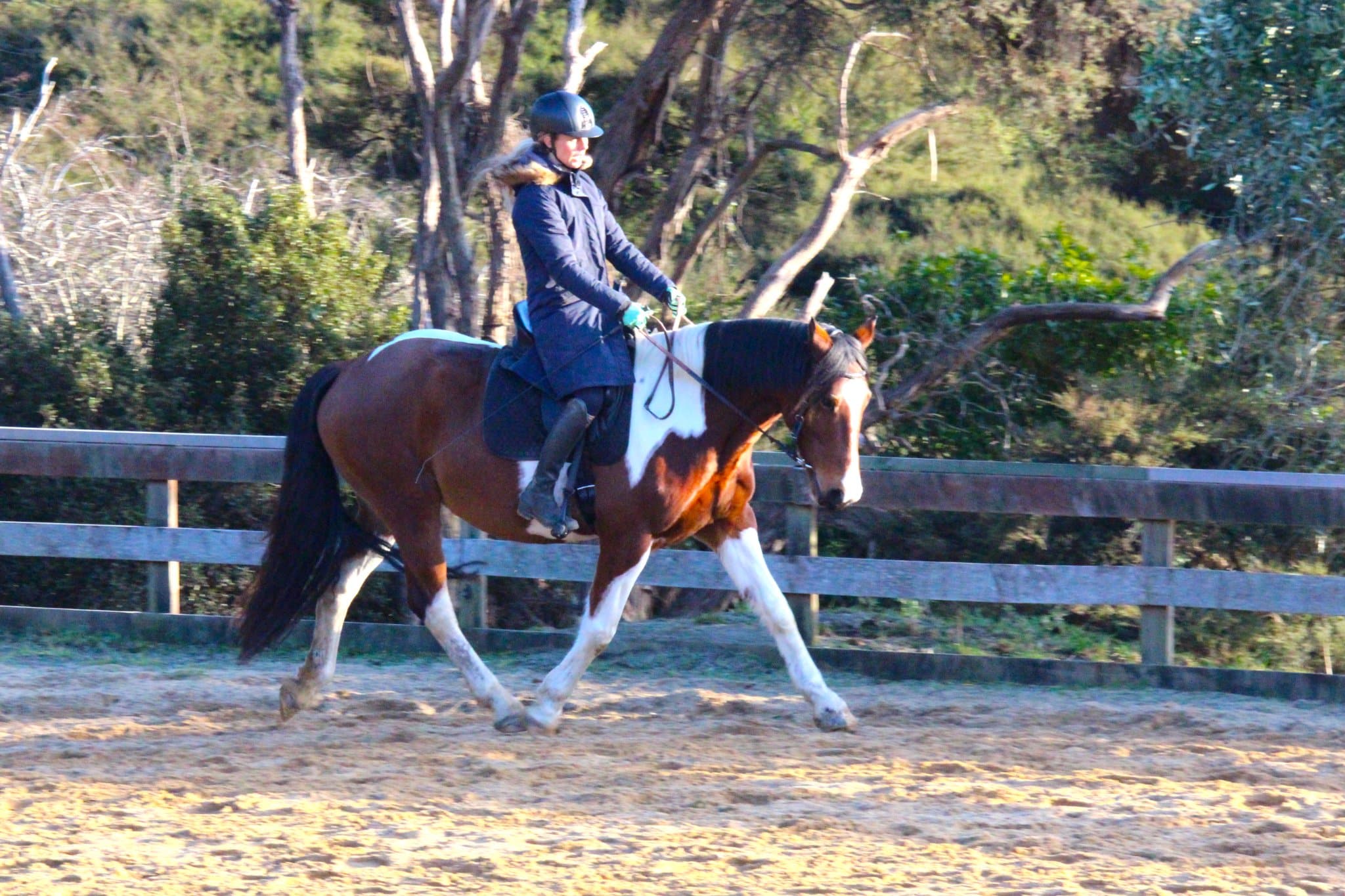
Later in the day, I searched through my photos to find the original ones I had of him (I always lament not taking earlier videos for comparison!) and found one from the day I tried him out. This photo here is a photo of Merc when I first went to see him (January 22, 2022)- our first ride together.

This photo was taken two days ago (June 14, 2022). To my mind, this is a big change in the space of 4-5 months.


I delight in this not only because I’m so proud of my horse (a horse with a willing heart and mind is worth their weight in gold and makes up for any capabilities they may initially lack gymnastically) but because this evolution has been such a team effort.

Firstly, I am grateful for the practices I learn and teach. It has given me an ease in my body and an outlook that allows for me to find balance even when the work feels messy and hard.

I knew from the start that I would need some assistance with Merc to correct his imbalances. He was heavy on the forehand, particularly on the left fore, that left him falling in through the shoulder. We had to renegotiate what the leg aids meant between each other to really establish forward, and to develop a conversation that worked for us.

Since March, I have been mentored by Kate Sandel and together we formed a training program. I followed the principles of Legerete, the French classical school of riding, that allowed me to work with Merc’s balance so he could more easily meet life as a riding horse in a way that facilitated more capability and ease of movement rather than the opposite.

Without learning to lighten his shoulders, lift the base of his neck and adjust his balance under saddle, I think a horse like Merc could easily have ended up unsound as a riding horse, simply because his natural body habits over time would have created soreness. I’m sure he is not alone in this.

We are also fortunate to have Dale Logan on team from DL Equine to form a diet for Merc that ensures he’s getting what he needs- no more and no less. We revise the diet with every change of season and I’m just about to send off his measurements, pasture photos and updates so we can revise things from where they were previously.

Horsing is such a team effort, and I’m grateful to have a collection of fabulous people in mine. And the other thing is, I don’t live near any of the people I’ve mentioned- across the world from Kate and on another island from Dale. We all work remotely.

I love what the internet has provided us with. I love the work that I do. And I love adventuring with my beautiful Merc.

Onwards.

❤️ Jane

You can visit Kate’s website here.

You can visit Dale’s website here

The Relationship Of Your Seat To Your Pelvis & Pelvic Organs

The position and shape of the pelvis changes dramatically depending on whether you are in a parasympathetic or fight flight nervous system state. In the sympathetic state, the entire rim of the pelvic bowl folds in and up, and it’s from this position that most of our instructions are the seat are given. The amount of us living dominantly from our fight flight systems has become so vast that we’ve come to accept and recognize the pelvis being in this position as the norm.

The resting place of the pelvic organs also will have a dramatic effect on weight distribution and pressure in the saddle. In the parasympathetic, the bladder would sit behind the pubic symphysis and bear weight on the cartilage, acting as a stabilizing force. It runs an energetic line somewhat like a half pipe towards the tail.

In the fight flight system, however, the colon starts to shift forward, tucking the tail; the bladder starts to lift up. As it’s fascially attached to the pubic symphysis, this starts to lift up too.

This has a flow on consequence for the abdominals; the pubic symphysis is attached to both the rectus abdominis and the linea alba and as the bladder starts to rise up, it causes the fibres of the abdominal muscles to overlap, altering their homeostatic length and making them incapable of contraction.

All of this occurs to bring the organs close together for both protective purposes and also for efficiency; if the organs are grouped together, the body doesn’t have to work as hard to pump blood to them.

If you lie flat on your back, you can gain information about where your pelvic organs sit by gauging where you feel the most weight. If the top of the tail and sacrum meet is where you feel the pressure (the top of the tail is where your butt crack is, or where the glutes start to part), then the bladder is most likely low.

If you feel the weight higher, it tells us that the colon is more weighted down and the pelvic organs are sitting higher.

As your organs shift, your weight shifts. Organ position directly affects your centre of gravity and ability to maintain an open and stable posture.

Onwards.

❤️ Jane

The biomechanics and sensing work I do in my membership program, JoyRide, allows us to establish adaptability and responsiveness in the nervous system so that the structure of our body is free to take up the most optimal positioning. If you are interested to read more or work together, you can check it out here


The Abdominal Wall, The Pelvis & The Seat: Looking At Abdominal Contraction In The Saddle

The subject of core strength and how to properly use and train our abdominal muscles get a lot of airtime when it comes to conversations around seat and position.

Typically, when we think of the breath and what is labeled as a full, diaphragmatic breath, this area is heavily recruited also, as we draw the belly button in on the inhale and allow it to release on the exhale.

But what happens to the rest of the body when we engage the abdominal muscles in this way? How does it affect our pelvis and our seat?

From a nervous system perspective, the stability of the abdominal muscles is necessary to preserve the space between the bottom of the ribs and the top of the pelvis, so the integrity of the lumbar spine can be preserved, and the fascial trains can slide.

When I contract the abdominals, so the belly button gets pulled in, I now force my pelvis into a posterior tilt and prevent the two sides moving independently.

As a result, instead of the fascial trains moving and sliding to power movement, the lumbar spine gets to work, moving in and out of the tube of the body to allow us to move through space, and causing compression of the vertebral bodies, with a shortening on one side and a lengthening on the other.

In this video, we take a brief at the connection points of the abdominal muscles to the pelvis, the superficial front line fascial train and the role your nervous system plays in your biomechanics. There is so much more to discuss here but hopefully this provides a start point to see how some of your current movement habits might be hindering rather than helping.

Onwards.

❤️ Jane

If you are interested in joining me for my membership, you can check it out or jump in here!


The Difference Between Freeze & Collapse

The “fight flight response” or the “fight flight nervous system” is a common nickname given to the survival or sympathetic nervous system. It can be misleading, however, as far as overly simplifying how the body responds in survival mode and can narrow the conversation to one or two elements in what is a much bigger field.

It’s common to read things online such as “don’t forget there’s also freeze!” when it comes to conversations on this topic (assuming that fight and flight are the main players), or to group together the states of freeze and collapse, which are vastly different from each other, and should be understood as such.

There is actually a stage before fight where the startle reflex kicks in, and three further stages beyond freeze that cause the body to move into further stages of shutdown. Each of this has their own set of structural changes in the body, as well as behavioral expressions that accompany them.

Understanding what is presenting in both horses and humans is important as it allows us to make decisions as to what sort of movement might be useful to help ease the system into a more adaptive state, and the overall approach we want to take.

For instance, in collapse, the brain is essentially telling the body not to move. If we then “prescribe” vigorous exercise for someone in a state of nervous system collapse, we not only send them to battle with themselves mentally, but systemically it can create some dire consequences.

As opposed to the rigidity of freeze, there’s a laxity in collapse (with the final stage moving into rigour).

We can have lots of “ideas” about what might be good for us, but we need to remember the brain is always making choices for the body based on the sensory information available to it. This must be respected first and foremost. We are never purposely working against ourselves.

Instead, we have to ask, why is my brain choosing this for my body? And how can I best support it to see things differently?

Onwards.


The Difference Between The Fight Flight & Parasympathetic Brain

The fight flight brain looks for things that are the same.

“How is this experience the same as what I experience yesterday, or last year, or ten years ago?”

It searches for same-ness and eradicates difference, causing us to erase or not notice the things happening in our present moment that show us something is changing. The things which indicate progress.

The parasympathetic brain notices differences. It pays attention to all of the variables, all of the changes in our present reality that show us that we are different, that things are different from yesterday.

If you can start to notice differences rather than same-ness, you will start to meet the reality that you are changing all of the time. You allow yourself to be new. And in that new-ness, you can start to create a different set of circumstances.

Search for the 1% difference.

Onwards.

❤️ Jane

{Letters To My Body} Dear Breath

Dear Breath,

Oh my, Breath, where do I even start? I think of everything I do and teach and share… when I talk about you, Breath, I get the most kick back. People are very attached to controlling you. Did you know that? Very attached.

Let me tell you, I hold no judgement there. In fact, I am the least judgey of the judgey judges when it comes to all the stuff with controlling the breath and people’s attachment to it. Why? Well, for years I was kind of a pro at understanding you- or so I thought.

And I don’t mean a self-proclaimed pro with a big TikTok following. I mean, I studied you, was given qualifications in you. I spent a chunk of my day (every day!) manipulating and contorting you. I could hold you, release you. I would separate you so you came out one nostril and in the other. You went along with it, you’re very gracious like that.

I would segment you (or so I told myself) so you were either in my chest or in my belly. I would try to make you bigger or smaller depending on what it is I wanted to do, how it is I wanted to control you, how it is I wanted to control myself.

And it’s funny, Breath, as I write this, I think, what exactly what I trying to do? And I think at the base of it, my motivation for working with you in the way that I did was not so much to feel something but to NOT feel something else.

It was to not feel anxious. To not feel fearful. To not feel like I didn’t have everything under control.

So, success, then, Breath, felt like the absence of all those things. The absence of them as thoughts in my mind, and the absence of them as feelings and sensations in my body.

I’m not sure if we use you, Breath, to move towards something as much as we do to move away from something, but I’m pretty sure it’s the latter.

Anyway, I don’t know if you read my letter to my Head, but if you did, it would save us some leg time here. If was to summarise, I would say that when I started learning about the nervous system, I started to understand the body- my body- working as a team. And when I thought of all the different parts of my body working as a team under the head coach Brain, I realized that so much of how I approached things previously had been to segment things… like I could choose a part, go in with my tweezers, pluck it out and isolate it. Because I knew best. But you all needed each other. You relied on each other as a team, to really work best.

But that’s what I did with you, Breath. I isolated you not recognizing that the brain, your coach, and you had chosen how you worked together. When I think back now, I feel foolish. And maybe a little arrogant. I assumed that I knew best, that I could bend you to my will, when you and Brain actually knew so much more.

You had checked on all the systems. You looked at all the tubes of my body, and the pressure in my veins and the alignment of my bones and the information from all my senses… you clocked it noticed it and adjusted my breath in the best interest of it. I see this now and I think, that’s magical. How amazing that you do that.

And along with thanking you, there are three other parts that I want to thank as well- Heart, Lungs and Deep Front Line of Fascia. Honestly, while I’m here tipping my hat, I just want to say…

Deep Front Line (and fascia generally)…. I had NO IDEA about you when people taught me about the breath. It’s not like you were given a fleeting mention. It’s like you didn’t exist as part of the conversation which now seems wild to me. And was no doubt very frustrating for you.

To think that all this time you were INTEGRAL to the function of how my body was breathed and no-one even cared to give you a mention. It’s a travesty. But I understand you now and I want to make amends.

So, as part of my overall letter of apology to you, Breath, I want will tie in all of your friends that I mentioned above and say this:

I understand now that how I breathe; how fast, how deep, how much is chosen for me by my brain. It’s chosen based on understanding, parameters and co-ordinates that sit far outside my conscious awareness.

And if I override this, you and Brain freak out a little bit. You are like, why is she doing that? We have chosen this for her, but she’s pressing the override button? We better lock things down!

And so you kick me into my survival nervous system not because you are at war with me. Because you really want to look after me.

I understand now that my conscious brain can set my intention for what I want things to be but it’s the role of my unconscious brain to decide how that happens. I’ve tried to do it all consciously, Breath, and you got caught up in that. I’ve decided not only how I want things to be, but I’ve also tried to control how you do it and it’s got us into a bit of a pickle.

I won’t do that anymore.

Thanks for being so understanding, and for taking care of things even when I wasn’t thinking about you. I appreciate you.

❤️ Jane

Of all the things we are taught about when it comes to body and mind control, on most occasions, the breath is right up at the top of the list. If we zoom out from the breath for a moment and consider the brain, the unconscious brain is always making choices regarding how the body functions based on sensory input and it adjusts everything from internal pressure to flow to breath rate based on that information.

Our conscious brain is not privy to such a vast well pool of information so when we make choices about HOW the body functions- which includes controlling the breath- we are overriding the choice that our unconscious brain has chosen for us. We are overriding a choice that is much more informed.

Every time we override the choice of the unconscious brain to influence how the body works, we activate our survival nervous system. Why? If the actions of the conscious brain sit differently to what the unconscious brain is perceiving, the sympathetic system is activated as a “just in case” policy. A “just in case we missed something” move to keep us safe.

But let’s talk about fascia for a moment. The Deep Front Line is a fascial train that extends from your big toe all the way up to your head. It also wraps around the heart and the lungs; the pericardium itself is part of the Deep Front Line (DFL). When the DFL is sliding and active (which occurs when we are functioning in the parasympathetic system), it controls breath rate and respiration in coordination with the movement of the body. In this way, our breath rate and capacity are always in harmony with our physical output and needs.

Respiration in the parasympathetic system is not confined to ordinary respiration as we know it; respiration occurs as a system. There’s cellular respiration, digestive respiration, organ respiration, the list goes on. All working together, all supporting each other.

Controlling our breath stems from thought patterns of conscious control; we are wanting to control our response, control our feelings, control our reactions, control our body, control our behavior. A conscious idea of what or how we should be in response to life situations.

Our conscious brain is not designed to control our body or our breath. It is designed to support our unconscious processes. Your current breath rate is the perfect rate for you based on the internal pressure systems of your body, how hydrated your fascia is and where your bones sit. It has been chosen for you based on the stream of information provided to your unconscious about the current state of play in your system.

In the parasympathetic system, breathing is barely perceptible. Nor should it be. Our body is breathing itself all the time; it should not be a novel experience that captures our conscious brain’s attention.

When you override or control the breath in some way, why do you do so? And how do you know if you’ve been successful?


Balance, Ease & Symmetry: Can Your Nervous System Affect Your Riding Position?

The superficial front line of fascia is a literal line that travels up the middle on the body. In the movement work that I practice and teach, the Centerline is our north star. Awareness and coordination of the Centerline in movement is what allows not only for openness of the system overall, but for balance, coordination, and symmetry.

Symmetry in and of itself is an interesting discussion. Most conversations on rider posture and position discuss symmetry from the point of view of left-right balance. In other words, if we drew a line down the middle of the body, we want the left and right sides of the body to sit equally either side of that line. We often judge the idea of symmetry from a visual aesthetic (Oh, that looks straight! Yes, that looks more balanced now!), rather than considering the parts of the body at play that contribute to functional and healthful movement… which is more about how the internal structures of the body move that how the outer tube of the body appears to the eye.

In my work, we consider symmetry to be present when the left side of the body is working in coordination with itself (and conversely the right side also). So as my pelvic girdle on the left moves, so does my rib cage, shoulder girdle, skull, and legs. They all move together. In functional movement then, my Centerline may sit closer to the left side of my body than the right, but for as long as the entire left side coordinates, I am symmetrical.

Now back to the Centerline. In the parasympathetic system, it is the fascial trains and organs that motivate movement. This means that no matter if the body is in an arch or a curl; no matter if I move left or right, the distance between the coordinates of my Centerline stay the same. As a result, I don’t experience compression and my body naturally seeks to harmonise with the movement of my horse and my Centerline coordinates with theirs as the balance point.

In the sympathetic system, movement and force output is generated by the lumbar and cervical spine. The fascia dehydrates to compress the bones together, so I have more surfaces of acceleration to power off. Now, instead of my Centerline staying the same length, it shortens and lengthens, producing compression on bones and vertebrae (lower back pain or neck pain anyone?).

In our sympathetic state, we also use our abdominals to create breath, causing the fascial trains to lose tension. Loss of tension means, once again, that they can’t move or slide, causing a loss of integrity overall and patterns of restriction and compensation in the body as a whole.

In my membership program, JoyRide, I am teaching a workshop of Movement Arcs that explains the relationship of both the Centreline and Lateral lines in movement, and how our knowledge of them can create a more easeful experience in the saddle.

Why is this relevant to you? Here are a few reasons

  • Understanding how the body moves differently in the different nervous system states is an important part of being able to understand your own “stuck points” from a position point of view (and what’s more, begin to change them)
  • If you are moving in dominantly sympathetic or fight flight movement patterns, your body will be compromised physically over time. Fight Flight movement is designed for short bursts- for purposes of survival. But when we have inadvertently either become “stuck” in a sympathetically dominant state or learn certain movements with a sympathetic motor pattern, we are essentially compressing the structure of our body when we move.
  • Emotionally and mentally, your motor patterns intrinsically affect your emotional wellbeing. If you rise to the trot for instance in a sympathetic pattern of movement, you will be firing off your fight flight nervous system even when the circumstances don’t call for it.


You can check out the membership here. I’m also producing a series of ridden audios included in the membership to support the work we are doing out of the saddle.

❤️ Jane


How Do You Define Threshold? How Do You Know If You’re Over Or Under Yours?

Thresholds. It’s a word that we hear a lot applied to both horses and humans.

How do you define threshold?

And what markers are you looking for to determine if you (or your horse) are under threshold? Or over it?

This video snippet is from Stable Hours, the live Q&A session we hold every week in my membership program, JoyRide. The conversation around threshold is, in my experience an interesting one, because we often use highly subjective interpretations of threshold based on feelings of comfort (or discomfort).

In my program, we discuss how to recognize the fight flight or survival nervous system response of the body based on structural indicators rather than subjective interpretations of what we *think* is happening in our body. As we move into a sympathetic response, the structure and biomechanics of our body starts to shift. When we can recognize these shifts, we can start to decouple our thoughts about stress, capacity and being in overload from the reality of where our nervous system is sitting. A liberating and eye-opening experience.

In this video, we discuss thresholds and how having a fixed plan broken into baby steps can hinder rather than help progress.

Onwards.

❤️ Jane


If you want to learn more about my online program, you can do so here.

If you find this video helpful, please feel free to share!


{Letters To My Body} Dear Head

Dear Head,

For the longest time we had a complicated relationship. I won’t be so arrogant to assume that I completely have you sorted. To profess sounds like it would create the perfect opportunity for you to help me fall on my face. But I do have a different point of view of you now. A point of view that gives me a certain distance from the things you might tell me, but even more than that, the things that you might have me believe.

When I refer to you head, I’m not refer to the mothership that lives inside you. The brain is a part of you, but it seems to me that if we refer to you, Head, we are referring to a type of intangible conversation. One that accompanies us all day and for some of us, all night, that is not able to be identified by someone shining a light into our skull and pinpointing a geographical location.

Head, those conversations… it’s like they are everywhere and nowhere all at once. And they are completely unique to us. It’s like we all have our very own radio frequency beaming out (or perhaps moreso beaming in) that only we can hear. And the more ironic thing, Head, is that those words that we hear often aren’t the same words that we express. It’s like sometimes we know you aren’t right or true, but you contain us in our own private world that we often try to hide for fear of seeming crazy or kooky or not ok.

I even gave the negative version of you a name.. the Itty Bitty Shitty Committee. Using humour helps me make you seem not so heavy. It helps me step back and go, you aren’t me and I see you all at once.

It’s the weirdest thing.

Anyway. Growing up, I had many conversations with you. Some were good. But many weren’t that good. You talked to me of many things that weren’t so much about me alone but me and other people.

Your body doesn’t look like that, you would say, pointing me to someone over there. We stood together in the musty highschool change room getting ready for swimming and head you told me how to hold my towel so I could hide for the longest time, before getting swallowed by the water.

You said I was too skinny, too flat chested, my hair was too big for my head. You convinced me of that so when other people mentioned it, it was easy to believe them.

I know, I would think. You are just tracing the words I had already written. I know.

When you and I saw people around us suffering we made ourselves blend in. Don’t make life harder, we said to each other. Don’t make any ripples. Be the straight line on the page. Don’t be the cause of someone else’s upset. Be a good girl. Don’t get into trouble.

So, I held my breath and tried to be the straight line.

Head, when I look back, my eyebrows tangle. How exhausting, I think, to always be a straight line, when everyone knows the pencil always slips. How tiring that must be. Was.

And then I think of Minnie. Minnie was my pony. A red mare. Do you know what people say about red mares, Head? They say the strangest things. My red mare was proud and gentle and fierce. So, when you and me, Head, had a rough day, moment, week, she would say, come up. Let me carry you. And I did.

I let her carry us, Head, and she never minded. She never minded my confusion or my upset. I didn’t try to give it to her. I don’t think I even knew I was carrying it. But she took it anyway. She carried it, even when I didn’t know she was.

She always brought me back. My Red Mare.

I went to an astrologer once. I wanted her to tell me what was going to happen. I wanted her to map it out so I could relax and say, see? It’s not up to me. It’s already happening. It’s written in a map, in the stars.

Are there horses? I asked. Horses in my future? Do I work with horses?

No, she replied. No horses.

I paid her money, Head, smiled, and thanked her. But inside me and you didn’t like her.

20 years later, Head, is it too late to ask for a refund? If I’m the norm, I hope she’s in a different line of work.

Head, for the longest time, my work revolved around you. I blamed you for a lot. I gave you a lot of power.

I though, Head, you know what? I think getting you under control is the key. I will flip my thoughts. I will write the affirmations. I will focus on what it is I want. I will do all the things.

Sometimes it worked, Head, but you and I both know that you were always planning your own Shawshank Redemption. You might have been locked in a room, but I didn’t know you had a small spoon that you were using to dig your way out. I convinced myself that I had the answer, thrown away the lock and key, forgetting that you were the one who built the room in the first place.

The thing is, Head, I didn’t extend you enough compassion. I thought you were the engine when you are the caboose. Really, you’re just getting pulled along behind. A satellite station in a bigger galaxy. I thought you were the galaxy.

Now I work differently, live differently. I may not understand you all the time, but I get where you are coming from. I get that you are loudspeaker but something else hits play. I get that now.

Head, I’ve been studying a lot. You know that. You’ve been with me the whole time. And I know it sounds cliché, but …. You’ve changed.

I don’t hear from you as much as I used to. And I get the feeling you like it. You’ve unbuttoned your jeans, sat back on the couch and been like, thank God for that.

Perhaps you knew all along that you weren’t in control of things, didn’t want to be in control of things. But I made you in control. I didn’t know another way, Head, so I’m sorry about that. It wasn’t my intention. But I get it now.

So, here’s what I know now, Head (I’m preaching to the converted, right?). I now know that inside the edges of my skin lives a super-highway. It’s called my nervous system. It’s collecting information, feeding information back to the mothership, back to my brain. Our brain.

The superhighway is designed to be in free flow. It should be like New York from the window of a plane. So many lights. So much movement. I didn’t know it was that big, I would say, nose pressed up against the window. It goes forever!

Our nervous system from the window of a plane.

But then, you see, what should be New York can become a country town with a single street light. We fly over and think, where’s the airport? We don’t know where to land. It’s so dark. It is safe to come down? We watch the CCTV.

The radio controller (that’s you Head) in New York has so many options, so many things to pay attention to. The lights are moving, changing, responding. No two moments the same. You don’t get stuck here, Head, because you’re taking it all in. You’re alive. It’s so big, you marvel.

But for some of us, Head, in some moments, we become the single street light. And we get stuck. We keep looking and think, it seems the same? Do you notice anything changing?

We keep staring at the screen, not noticing that the battery has died and now the screen is stuck.

Things do change, Head, in New York or in the Single Street Light Town but when you are talking to me in the way that you sometimes do- when it gets dark or black or blah blah blah- you are not noticing the change. You are a Single Street Light Town on a screen where the battery has run out.

I understand now. I understand the way you talk to me depends on whether my nervous system is a map of New York or Single Street Light Town. And that all the years I was trying to get you to change, I didn’t adjust the map or change the batteries. You were just telling me what you saw, but the view was staying the same.

I’ve changed the map now, Head, and I don’t know about you, but it feels like we are friends. What do you think, Head?

Shall we take another spin across the skies?

Thanks for everything,

❤️ Jane


Afterword: Notes on Controlling Your Head. Or attempting to.

It’s a usual state of affairs that people approach the challenges of confidence, negative self-talk, negative beliefs and everything in between from the level of the mind. If you type in a google search or open any text concerned with wellbeing and the mind, you will find endless sources of encouragement that talk about controlling your focus, controlling your thoughts, thinking positive, how to eliminate negative self-talk.

The list is endless. I know most of all of what is there because I’ve not only lived it, I’ve taught it. The thing with trying to control your mind or your thoughts is that you are always behind the eight ball.

You can only change a negative thought to a positive one after the negative thought has occurred.

Changing your focus also exists in a binary. To focus on what you want, you must first recognize what you don’t want.

It’s easy to get into a situation where we feel like we’re chasing our tails, or we feel shamed or ashamed for our inability to create the type of mindscape we are told is possible.

We tighten, we control, and we exhaust ourselves.

My work now centres on the nervous system and the brain; our thoughts are simply biproducts of where our nervous system is sitting. Within the sympathetic or survival nervous system, there are seven motor reflex responses, seven different ways our body’s change in response to threat. And in line with those changes lives a template of behaviors and thought patterns; a shared human experience. Evidence of our shared humanity.

Understanding your nervous system sheds light on why you experience the things that you do at the level of your mind. It allows you to understand why your Head is the way that it is. Why it thinks the thoughts that it does. And why it’s ultimately doing its best to protect you.

Trying to change your Head without addressing or understanding your nervous system will have limited success. You are trying to change what you see on the screen without noticing the screen may be stuck, or the program you are watching is running on repeat. It’s a nevery ending loop.

Moving yourself to a place where your nervous system is adaptable means things are always changing. You are always changing, responding, adapting. You are no longer a Single Street Light Town. In the best possible way, you are New York. Your brain sees the options, the opportunities and whispers what is sees to your Head.

Change your nervous system and your thoughts change also. But not through force or control. As a natural biproduct of a system that’s engaged, mobile and present.

Meeting Reality Without Embarrassment

I was listening to my lovely and rather fabulous friend Kate Sandel the other day in a conversation that she was having about separation anxiety. She mentioned something that really struck me, which was the willingness to confront the reality of the situation without embarrassment or shame; so in this instance, being able to recognize what truly was going on with your horse without judging either you or them harshly.

I really appreciated the pairing of these two things together- reality without embarrassment- because in my experience, this is exactly what gets in the way of us being able to acknowledge the truth of where either ourselves or our horses are at; physically, mentally and emotionally. Many of us only want to look squarely at reality when it is pleasing to us. When it fits the rules of how we want things to be, or when the outer circumstances create a feeling state or sensation in the body that we have attached a positive label to. Happiness, joy, love, contentment, etc etc.

When this isn’t the case- when the reality of our situation challenges us in some way- we choose to look away, slightly to the side, or pretend it’s not there at all. The irony of this being that in our choosing to not “see” what is truly there, it can never transform. Our lack of a willingness to see is what keeps us stuck.

In the parasympathetic system, our nervous system responds to the reality of the moment by creating a whole new pattern, a whole new response to life that our body has never lived before. After all, the present moment is a moment we have never lived and thus, if we are truly responding to reality, our response is one we have also never seen.

In the sympathetic system, we are reflexive. That response might be appropriate if our circumstances call for it. But if we are operating on a loop that has little to do with what is happening now and everything to do with what is happening in the past, then we are no longer seeing nor experiencing reality. The experience of shame and embarrassment of what is takes us on that loop.

The reality is now. It may not be the same in five seconds, five minutes, five days or five months. But any and all transformation begins with accepting reality as the present moment expression of truth for what is currently being experienced.

And that’s never something to be ashamed or embarrassed about.

Onwards.

❤️ Jane


Unconscious, Subconscious, Conscious; Exploring How Your Mind Lives In Your Body

The other day in my JoyRide group, we started talking about the difference between conscious, subconscious and unconscious, and I thought it would be an interesting discussion to have here also. It’s an interesting one because it’s helps to clarify how your experiences live in your body- and how past experience can cycle through to the present. Please note these are the definitions that I use in relation to my work and I appreciate there will be others out there who operate with different ideas in mind.

Unconscious refers to the autonomic nervous system, that is under our unconscious control. It’s the process of my brain deciding, should we send out a parasympathetic or sympathetic (survival nervous system) response in this moment? Depending on which system it chooses, the entire structure of our body, from the invisible layer of hormones to the outer tube structure, changes.

Subconscious refers to thoughts and patterns that were once conscious but are no longer. This may be due to trauma, an inability to cope or surrounding circumstances. The original choice of the body was unable to be expressed in its truth and so it’s now stored as part of a sympathetic reflex pattern. We use subconscious here because although it is now unconscious, it was once conscious.

Conscious is a little more self-explanatory in that it refers to all of that we have conscious awareness of.

So, here’s where things get more fun. In my work, I’m interested in motor patterns. The motor patterns of the body- how the body expresses in movement- and understanding more about it is what allows us to shift out of stuck patterns of behavior, to move beyond limiting patterns in the body that relate to posture, health and wellbeing, and to create the circumstances to be truly present.

Let’s say that we notice that we are cycling through the same pattern, day in, day out when we step into the arena. This could manifest emotionally- anxiety, frustration, constant thoughts of not being good enough; or it could manifest physically; you can’t stop yourself leaning forward, you grab with your hands, or your left leg doesn’t ever seem to do what you want it to.

All of these- anxiety, frustration, constant thoughts of not being good enough- have physically expressions. They all have their own motor pattern that get activated and live along with the thought. The two are so closely linked that it can be difficult to decide what came first, and it’s possible to be one or the other; you are stuck on a story that liberates the physical pattern, or a physical pattern is expressing that is tied to those thoughts. In the case of the physical example, the same is true.

In order to change any pattern in the body, we must first be aware of what that pattern is; the subconscious needs to once more become conscious. As we work through the movement work, the first thing to occur is an awareness of the current, existing pattern. We observe this pattern without consciously trying to change it.

As the brain consciously observes the pattern, it begins to change things at an unconscious level. The unconscious brain receives more information which allows it to decide if the dominant pattern it has chosen is still relevant.

From here, in order for the pattern to leave, the unconscious brain reveals all that is subconscious to the conscious brain and once that has expressed, a new pattern can be established. This is not something that can be forced; it’s something that the brain and body chooses.

It also (hopefully) demonstrates how intimate the relationship between our thoughts, emotions and physical expressions are.

Onwards.

❤️ Jane


Spooking Is A Healthy, Natural & Wanted Response

Spooking! We had an interesting discussion on spooking last week in Stable Hours (the weekly Live Q&A in my membership group) that brought a few important points to the forefront. This particular question revolved around a situation at a clinic where a water bottle was thrown on the ground, resulting in the horse spooking.

The horse had, by all observations, been relaxed prior to the spook occurring, which raised questions such as:

Had we missed some underlying tension that resulted in the spook?

Was there anything we could do to perhaps prevent the need to spook in the future?

How can we best deal with a spook?

What we call a spook is in nervous system speak a demonstration of the startle response. There are several stages of sympathetic reflex that we move through in our survival nervous system, and the startle is the first. It’s when the brain begins to limit sensory input to a narrow window of focus so we can better assess a potential threat and decide where to take things from there.

Spooking is a healthy, natural, and wanted. In a balanced horse (emotionally and physically) we want them to respond to changes in the environment. It’s the same for humans. A lack of response to my mind is far more concerning than a horse who is noticing what’s going on.

How easily they “come back” and readjust is more of an indication of where they were sitting at the start. If the water bottle was to drop, for example, and they metaphorically hit the roof and it took you an hour to find an even baseline again, this gives you information that their resting point was somewhere up the sympathetic chain. We definitely want to pay attention to patterns. What this conversation revolves around is the often-held desire to eliminate spooking altogether.

What’s important to remember is we train and work with our horses to support, facilitate and promote their natural curiosity, beauty, and aliveness, and to allow for greater balance between us; we are not looking for our horses to flatline.

And if that’s something that *you* require to feel safe to proceed, then that tells you more about the state of your nervous system than it does about your horses.

A healthy state of being is robust, responsive and notices change. A healthy current of aliveness.

Onwards.

❤️ Jane

You’re Much More Likely To Notice Your Progress If You Let Go Of Your Attachment To What It Should Look Like

Having a sense of progress is important, but it’s easy to miss the small, everyday markers of progress if you are attached to what progress should look like.

Being able to notice and appreciate progress in training involves:

  1. Total acceptance of where you are currently.

If you are desperate to change or escape your current position, you are already fixed on an outcome. When we’re fixed on an outcome, we’ve already created a mental model and how and where we think things should be, which colours our perception and observation, and prevents us from seeing the subtlety and nuance of day-to-day changes.

  1. Letting you and your horse be new every time you meet

I mentioned this a few blogs ago, but letting yourself be new means that allow yourself to meet the training session and see what presents. You don’t have ideas about what’s going to happen. You don’t presuppose that your horse is going to respond in a certain way. You don’t presuppose YOU are going to respond in a certain way.

This extends beyond the mental and emotional to the physical also. You don’t label your weak side or bring the story with you about your stiff left shoulder or how your horse always drops to the inside on the right rein. None of it.

You let you and your horse be completely new every time you meet.

Every thought we have has a corresponding motor pattern in the body. Our thoughts play out in our physiology. If we have habitual thoughts, we are consistently expressing habitual patterns as part of a sympathetic reflex response and creating ground hog day scenarios as a result.

Let yourself be new.

  1. Observation without judgement

The brain learns through consistent and repetitious failure. We make a decision; take an action and we observe the consequences of that action. Our unconscious brain then tries again in an attempt to bring the outcome of our action closer to our original intention. In this way, every action we take is a success; every action we take is making us clearer, more efficient, and more in line with our original intention. Every repeated “failure” is a “success”.

Judgement has not functional purpose in the learning process, other to pull you into the workings of the emotional brain and limit your capacity to truly take notice of what’s happening.

There is no right or wrong, good or bad. There is just “how far from our intention did that action take us?” and “how might we get closer next time around”?

Onwards.

❤️ Jane

The Current State Of Your Nervous System Expresses In Your Movements

Your current nervous system state expresses through your motor patterns. It expresses in movement. This is an easy sentence to read and gloss over but the implications that it holds have far reaching effects on our health and wellbeing- physically, mentally, and emotionally.

If we break it down even further, for every situation we find ourselves in, our brain has two choices about how to respond. It can decide to respond with a parasympathetic response, or a sympathetic reflex. Those are the two choices.

At a fundamental level, what it essentially comes back to is:

Does this situation require us to fire up our sympathetic or survival nervous system?

If yes, this means the brain has registered a physiological threat. A threat to our physical wellbeing. And consequently, we fire off one of the reflex motor patterns in the sympathetic reflex chain.

If not, we respond with a parasympathetic pattern that allows the system to remain open. What this ensures is the sensory information coming in has traveled through our sensory motor cortex, and our brain creates a response that is unique to that moment.

If we then consider our day-to-day activity, every action that we take is a motor pattern come to life. How I rise to the trot. How my body moves at canter. How I apply a leg aid when I ask for shoulder in. The essence of these are all motor patterns.

When we learn any of these skills we can do so in the sympathetic or parasympathetic. What determines that is current nervous system state at the time of learning; the motor patterns we have mimicked from our parents or primary care givers that have informed some of our basic movement patterns; the learning style and conditions of which we were both taught and learned.

Every thought pattern also has a corresponding motor pattern in the body. So, if I am habitually thinking a specific thought, I will be continually expressing the same pattern in my physiology.

These few short paragraphs have covered a lot of territory, but the purpose is really to highlight this:

If you are looking to create a nervous system that is more adaptable and responsive; if you are wanting to shift out of reflexive modes of behavior or experience; if you are looking to change your posture, position, and movement…. addressing your motor patterns is a fundamental piece.

If you have a sympathetically dominant pattern of rising or posting to the trot, for example, you will be inadvertently firing off your survival nervous system, even if the circumstances don’t call for it.

If you are in a situation where your dominant mode of moving in the world is rooted in your sympathetic nervous system, this will reflect in your posture, seat, and position. Your body will be expressing its primary choice of the sympathetic reflex responses. And no amount of willpower or conscious manipulation will override it.

Understanding more about your brain and nervous system- even at a basic level- will gift you not only with self-compassion and empathy, but with discernment. The discernment to unpick what works for you and what doesn’t; to navigate your way through the internet forest of quick fixes and promises; to let go of teachers or coaches who foster reliance and dependency instead of information and self-understanding.

Onwards.

❤️ Jane

If you are interested in learning and sharing in this work with me, you can check out my membership program JoyRide. I’d love to have you join me!


Look up! Gaze, Eye Line & Posture From The Level Of The Nervous System

Look up!

Many of us consider posture and position from the viewpoint of the outer tube of the body. For instance, we see or sense that we are leaning forward, and so the most obvious correction is to shift the weight back.

We might notice that the shoulders are rounded and so again, the most obvious correction is to draw the shoulder blades back and together.

Or we realise that we are looking down and so we reposition our gaze to look up.

All of the above involves manipulating or changing the position of the body somehow so that it fits the outer form of how we should look when we are in “good posture” and where we “should” be looking when our structure and frame is open.

The problem is this approach ignores some fundamental principles:


  1. Why the brain has chosen to position the body like this in the first place
  2. That posture and where and how the structure of the body moves at any one moment in time is unconsciously controlled
  3. The body functions in relationship


Let’s use our eyes and our gaze as our focus point for today. The eye socket and the eyeball function differently between the parasympathetic and the sympathetic (or survival) nervous systems. In the parasympathetic, the socket itself is oriented closer to the outside of the skull and higher up, so that your natural gaze would lie in line with the top of your ears, and your focus generally would include a wide range of peripheral vision.

In this state, the eyeball itself orients medially to the socket, and it’s the socket that moves rather than the eyeball. Fascinatingly, our eye socket position is more like that of a horse- oriented more to the 45 degrees- which allows for an open and direct line of the optic nerve travelling to the brain.

In the sympathetic, these relationships begin to change, which naturally means that the relationship of all the rest of the bones of the skull change their orientation also. In the sympathetic system, the eye sockets rotate in and down. As opposed to the sockets moving in the parasympathetic, they now stay more fixed and the eyeball itself starts to move to follow the object of its attention. This, in turn, affects our vestibular system and our posture; the eyeball is attached to the organ bag of fascia and so its orientation affects our body from the top down.

The eye socket also mimics the humeral and femoral sockets, so your shoulders and hips are in direct relationship with your gaze.

At this point, what we need to reiterate is that consciously forcing your head up to look straight again does not change the underlying structures that have chosen this position for your body in the first place; to do so means you will now be creating different points of compression and going to war with yourself as the inner mechanisms and conscious ideas about how you “should” be conflict. And you may have noticed yourself that the adjustments only “work” for as long as you are consciously paying attention; they aren’t corrective.

Considering posture and the body this way is a paradigm shift, and one that can seem somewhat of an enigma. How do we change things if it’s not through conscious control?

The answer lies within the sensory nervous system. Through conscious observation, novel movement and activating the sensory nervous system, we can shift the body out of habitual fight flight patterning and change the way our body moves and holds itself as a result. Not to mention concurrently shifting the mental and emotional patterns that go with it.

This work is the foundation of what I teach; if it’s of interest, check out my membership program. Details below.

Onwards.

❤️ Jane

What Is Success?

An article popped up the other day in my newsfeed and the title was something like “5 Tips to help you become a more successful rider”. I giggle snorted to myself in that moment because my brain couldn’t make sense of it at all. ‘How is it that we even define success when it comes to riding?’, I asked myself. The idea seemed so….limiting.

Perhaps what struck me even more was how far removed I have personally become from judging or measuring my riding or horsemanship by any metric of success in traditional terms. I teach a number of movement classes per week in my membership program, JoyRide, and one of the things I am always saying is “it doesn’t matter if you know the answers to the questions that I’m asking. What’s important is training your brain to consider things in a different way”.

The essence of that statement is asking us to move away from the idea of a fixed outcome, of one place being “right” and the other being “wrong”- moving away from a fixed idea of how we “should” be at any one moment in time and instead, observing what is, taking an action, and noticing the changes.

Anyone who works with me will tell you that working in this way makes any patterns that you have around perfectionism, people pleasing or the need to get things “right” very apparent. When we step outside the framework of box ticking and matching ourselves up to a pre-conceived ideal, we are just left with… ourselves. We are left with… what is. And observing yourself without the masks or pretenses or need to be anywhere or anything other than where you are right now is not necessarily an easeful place to rest. It’s a necessary one, however, to let go of the conscious patterns of control that often rule our lives.

If you want to take care of the future, which is where much of our desire around the notion of goals and success comes from, you have to take care of the present. And for most of us, we are anywhere but present.

But back to the idea of success. To our brains, success is a foreign concept that opposes the very basis of learning. The brain learns through consistent and repetitious failure. We make a decision; take an action and we observe the consequences of that action. Our unconscious brain then tries again in an attempt to bring the outcome of our action closer to our original intention. In this way, every action we take is a success; every action we take is making us clearer, more efficient, and more in line with our original intention. Every repeated “failure” is a “success”.

This is a photo of Merc and I playing on the inlet after a “successful” schooling session. And if we are stuck on the term, to me it’s not possible to ride or work with a horse and not be a success. Sometimes you have greater ease of communication and connection and experience a sense of progress. Success. Sometimes, nothing is clear, nothing matches up with your intention or is smoothly communicated. Still a success. You notice, change, adjust and go again.

Success. It’s just a made up idea. And consequently, you can make up what it looks like for you.

Onwards.

❤️ Jane

The Seat & The Pelvic Floor

What you are looking at in this image is a drawing of the pelvic floor, looking from the top down. You can see how complex it is, and how the fibers run in various different directions.

You have the front to back fibers, running from the tailbone to the pubic symphysis. And then the fibers that fan out to the side like butterfly wings.

The reason for this arrangement is to allow for the independent movement of the left and right side of the pelvis. The long, central fibers elongate and move to allow for the centreline (the superficial front line of fascia) and pubic symphysis to move forwards and backwards in space. At the same time, the fibers to the side fan out like a stingray, allowing for the openness of the pelvis to be preserved and ensuring optimal motor function.

In the parasympathetic, the pelvic floor musculature hangs below the bony structures like a hammock; as it meets and outside force (such as the saddle), the fascia responds with an equal and opposing pressure, allowing for even surface contact pressure and the integrity of the system to be preserved in spite of changing environmental conditions.

In the sympathetic system, the pelvic floor draws up and in towards midline, pulling the bony structures together. The pubic tubercles at the front become compressed; the PSIS move closer together and limit the movement of the sacrum; the entire pelvis moves into a posterior tilt. When this occurs, the pelvis can no longer move each side independently, but can now only move in a teeter-totter action, as the lumbar spine goes in and out of the tube of body to power movement.

When we discuss the seat and position, we are often considering the pelvis within the window of its sympathetic motor patterning. In the sympathetic, the entire pelvic rim folds in and up; it does this to compress the femoral artery, to trap blood in the legs, and the maximise surface contact pressure through the bony structures by bringing bone on bone, to maximise our force output in survival situations.

So many of the cues we are given in riding situations visually recognize this fight/flight patterning but seek to correct it through conscious adjustment- which leads to a never- ending succession of course corrections as patterns of compensation arise in other parts of the body. We have to work with the underlying neurological templates that are choosing to place the body in this position in the first place.

Over the next couple of weeks in JoyRide, my membership program, we are working with the pelvic floor. Details below for those of you keen to join me.

Onwards.

❤️ Jane

To Your Unconscious Brain, Your Response Is Always Appropriate

One of the things we often do is “rate” the appropriateness of our responses according to how we “think” we should be behaving or reacting. I’ve talked about this in previous posts (I’ll link them below) but I want to approach this conversation from a slightly different angle.

To illustrate what I mean, let’s say you have a fall or accident, and it takes you into a freeze response- part of the palate of possibilities in the sympathetic reflex chain. To your conscious brain and conditioning, this makes sense. As either an observer or experiencer, you might think to yourself, yes, this matches. This makes sense.

If we flip to scenario two now and think about someone walking out to catch their horse and take them to the arena. Let’s say they too find themselves in the freeze response, but there’s nothing about the situation that they can rationalize led them to react that way. This one we respond mentally “less favorably” to, as our conscious brain struggles to connect the dots on what it is about our outer world that could have caused our inner world to respond in the way that it has.

But here’s the thing. It can be a dramatic accident or something hard for us to comprehend consciously (perhaps a look someone gave us, something in the environment, a specific movement)… if the unconscious brain sends the body into the freeze response, the internal experience is the same, regardless of how valid we consciously perceive it to be.

The internal experience is the same.

In this way, “ranking” our responses according to our perception of appropriateness is not useful. How we respond is not conscious. It’s under our unconscious control, and the reasons can often lie far outside the realm of what we can consciously understand or identify.

To your unconscious brain, it makes sense.

Onwards.

❤️ Jane


Let Yourself Be New

A little while back, I read a post on another page from someone who felt like they’d done the wrong thing by their horse in a training session. The crux of their question revolved around the idea of forgiveness. Essentially, how do we ask for our horse’s forgiveness when we know that we’ve screwed up?

Forgiveness, in many ways, is such a human concept that I’m not sure it’s possible to transfer it to the equine world. But I do have something that perhaps allows for a practical action to be taken when such situations occur, and I believe it to be the biggest gift that you can give both yourself and your horse. It is:

You have to allow both you and your horse to be new in every moment.

What does that mean?

Letting yourself be new means that allow yourself to meet the training session and see what presents. You don’t have ideas about what’s going to happen. You don’t presuppose that your horse is going to respond in a certain way. You don’t presuppose YOU are going to respond in a certain way.

This extends beyond the mental and emotional to the physical also. You don’t label your weak side or bring the story with you about your stiff left shoulder or how your horse always drops to the inside on the right rein. None of it.

You let you and your horse be completely new every time you meet.

Every thought we have has a corresponding motor pattern in the body. Our thoughts play out in our physiology. If we have habitual thoughts, we are consistently expressing habitual patterns as part of a sympathetic reflex response.

Let you and your horse be new.

It’s the biggest gift you can give both of you.

Onwards.

❤️ Jane