On The Mystical & The Magical

Our life, our body, our experience, our emotions are an intimate co-mingling with the world around us.

Wonder is our innate state.

Our lineage is one of beauty finding.

At our core, we reject shallow experience. We recognize we’re designed for a life that is sensuous, full, imaginative, and expansive.

You teach a lot about the body and the nervous system, Jane, what are your thoughts on the shamanic and the mystical, and its role in healing and wellness?

Well, to start the body is not separate from the mystical and the magical. In fact, it’s the very expression of it.

But beyond that, we have been sold a story that says the essence of who we are, our psyches, the body that we can touch with our hands, is separate to the landscape, the creatures, the wider world around us.

When in fact, we all spill over into, through and around each other. We do not exist, live, or heal in isolation. We breath individually and the collective also breathes us.

To partition ourselves of from the potential of wider sources of energy, wellbeing and vitality is much more than an individual error. It denies an interconnection that’s woven into the smallest cells of our being.

We may not always understand it. But to deny it only speaks to how we are facing the conversation; it does not cancel out the reality of its existence itself.

Onwards.

❤️ Jane

View Finding

To get from the paddock where Merc lives to the arena involves a mini expedition. We wind our way up the track, keeping left; a trail of water trickles down the other side, making it slightly soft under hoof. We come up past the yards and turn right, and through a covering of Manukas, alongside a little paddock where the rams live until the time comes for them to frolic with the ladies.

It’s about this point that Merc always stops. His body is still soft. He’s not concerned or worried. He’s not trying to get away from anything or to something else. He’s simply looking for looking’s sake.

And these days, I look with him.

I didn’t always join him. Some days, I used to encourage him on, saying come on Merc, we have things to do. Attached to my destination and overlooking the importance of the journey in between.

His looking, and now by default mine, I now call view finding. He stops and I check in and I know: Merc’s ok, he’s just view finding.

His view finding lets me see details I have never noticed despite walking that same piece of track many times a day. At this time of year, I see mushrooms pop up, new ones every morning. I learned recently that there’s name in one of the native American languages for the energy it takes for fungi to push through the earth overnight, and I delight that someone’s noticing and care at one point extended to giving that a name.

Our view finding lets us consider such things.

We view find on rides too, just looking, letting go of the idea that we need to be somewhere else anytime soon. Merc understands his place as part of the gift economy with the landscape and has gifted me with remembering my place also.

May we always create enough room for view finding.

Onwards.

❤️ Jane

Is Improving Your Posture Just A Matter Of Relaxation?

“So if a person is permanently stuck in fight/flight mode how does one release this to return lungs to normal position therefore improving posture? Is it just a matter of relaxation?”

This question popped up in response to the blog I wrote a couple of days back (I’ll post the link to that one below), and I thought we could pluck it out and discuss it separately because it raises a lot of interesting points.

The first is, it’s impossible to be permanently stuck in fight flight mode. Your nervous system is always flipping and changing, and even though it might appear like you are always in fight flight, there will still be times throughout the day when you are functioning in the parasympathetic.

In my work, we consider instead what is the dominant mode of functioning (and the same applies for our horses). So if we are more than 50% of the time functioning in the sympathetic system, we say that is dominantly sympathetic. And the reverse is true for the parasympathetic system.

If you are dominantly sympathetic, or fight flight, chances are you also have a dominant mode that you are more likely to operate from (fight, flight, freeze or collapse), and this informs both the structural positioning of your body, and behavioural patterning also.

If we stick with our discussion on posture and consider the fight flight nervous system, it’s important to understand:

  • The fight flight system is a system of reflex
  • Each of the fight flight reflexes (fight, flight, freeze, collapse) have structural positions that the brain organises the body in to maximise the capacities of that survival reflex

This is something that we all share. For every single one of us, the structure of our body from the inside out arrange itself in an identifiable reflex pattern that corresponds with the different sympathetic states. Once you learn to read structure, you can understand where someone’s nervous system is sitting by their structural positioning.

The other thing to understand is that this positioning is always a choice of the unconscious brain. Your parasympathetic and sympathetic systems are part of your autonomic nervous system, meaning we can’t consciously decide our way into a fight flight reflex, and we can’t consciously decide our way out. We can only influence the brain to make a different decision by increasing the amount of sensory feedback it has available to it (a discussion for another day!). Organ positioning is, of course, a part of this also.

If we take the second part of this question:

“…how does one release this to return lungs to normal position therefore improving posture? Is it just a matter of relaxation?”

The position of lungs (and all organs) are immediately influenced by what nervous system state we are in. In the parasympathetic system, the top of the lungs sit high in the neck tube, pressing on the deep front line of fascia and supporting the cervical vertebrae.

In the sympathetic, the drop down into the torso and wrap around the heart as part of a protective mechanism.

Again, this is not something we can influence consciously. We can only seek to provide the unconscious brain with more sensory information so that it is able to accurately respond to the situation it finds itself in.

{Side note here: when we are “stuck” on a dominant sympathetic template, we lose nervous system adaptability and are no longer accurately responding to the reality of our moment. My interest is in re-establishing this adaptability and developing, again, accurate responsiveness).

Relaxation is an interesting concept because it’s a subjective one. Our idea of a relaxed body is very different to a vital body. For most of us, we “feel” relaxed when our body sensations are absent or neutral, and we feel in control of things. This is not the same as a body in optimal functioning.

I flag this up because our attachment and association with a defined experience of relaxation gets in our way. A vital body is one full of feeling, sensation and sensory feedback. And in my experience, acclimatising people to this reality is one of the most challenging things in creating the nervous system adaptability we just talked about.

So as with most interesting questions, the answer is kind of yes and kind of no. And maybe. One of the key ways you activate the sensory system is through novel movement. I also have specific practices I work with in JoyRide, and I discuss a lot of the relationship to movement on nervous system function in Season 2 of my podcast. I’ll post some links for you below!

Onwards.

❤️ Jane

Posture From The Inside Out

A few years back, I remember having a conversation with Warwick Schiller about relaxation. I had recently bought my big warmblood mare, Nadia, and I had quickly back peddled from the idea of leaping on and both of us riding happily into the sunset to taking all gear off and starting right at the beginning. Her level of anxiety showed me that sunsets were off the list at least for the foreseeable future.

It’s interesting, I told him, as we nerded out. I had a body worker out the other day and she asked what I had been doing with her. She couldn’t believe how much her shape had changed. And I replied, the only thing I’ve been doing is playing with ways I could get her to relax.

At the time, I was ignorant to the depths of the workings of the nervous system beyond understanding that in people, if you felt nervous or afraid, or perhaps were depressed, you carried yourself in a different way. That made sense to me and was obvious. We’ve all had an experience of it, both in ourselves and observationally. The way that we can intrinsically read mood from posture.

Whilst at the time, I thought what I was observing was a muscular change, from my many studies and meanderings with the body since, I now understand it to be so much more complex. I could go on about the observable changes from a musculoskeletal perspective, but what I see gets the least amount of airtime in conversations both human and horse is the effect of organ placement and internal pressure systems on posture.

Just like the rest of your body, your organs and your horse’s organs are not static entities. They are in a constant state of motion, and their position is dictated by your current nervous system state. For instance, each of the fight flight reactions (fight, flight, freeze and conservation of energy mode or collapse) have corresponding motor reflex patterns that the body arranges itself too to best fulfill the function of that response.

The body prioritizes force output in fight. In flee, its emphasis is on acceleration. When these responses are chosen by the brain, it fires off a message to the body and your entire system (and your horse’s entire system) arranges itself accordingly.

The organs, of course, are a part of this. If you think about the hugeness (that’s an official term) of some of your organ structures (heart, lungs, diaphragm, liver) where they sit within the tube of the body dramatically affects your shape. In the parasympathetic system, for instance, the top of your lungs sits high in the neck tube, pressing on the deep front line of fascia and stabilizing the neck.

In the fight flight system, they drop much lower in the torso; the bulge that we see in the torso (the “hunchback” look for want of a better term) relates more to lung placement that anything else.

In the parasympathetic system, each chamber of the body is pressurized. This, in combination with a tensile and active fascial system and organs that are spinning and vibrating means that the body is supported from the inside out; there’s a vitality to the skin, a fullness of posture, a pliability of muscle.

This is what I was observing in Nadia. It wasn’t just muscles “releasing”. It was her entire system changing from the inside out. And this wasn’t something that was forced. It was a decision of her nervous system to operate from a different template, which affects things all the way down the line; physically, mentally, and emotionally.

In my membership program, JoyRide, we are working to the same understandings. If our nervous system is “stuck” on a certain mode of operation, our movement, posture, emotions will reflect this. Your movement patterns address this at its most fundamental level. You can check it out here if you’re interested in learning more!

Onwards.

❤️ Jane


To Be A Witness, Not An Investor: The Messy Business Of Releasing Old Patterns

She’s little, maybe 5 or 6 years old. She outside, playing in the trees. She’s alone, but she doesn’t mind. She doesn’t feel alone. She’s talking to someone, but from the outside, no-one would know who. Maybe it’s the trees. Maybe she has an imaginary friend. Maybe it’s to herself. Maybe it’s all of them.

She has no shoes on for no other reason is that she doesn’t think to put any on. She has dirt under her toenails, and patches of dust all the way up her legs. Her dress is slightly torn, but it’s not something she’s noticed. Not because she’s careless. She just likes climbing and sometimes things get caught. No matter.

When she’s not talking to someone or something around her, her body hums her. Little vibrations of sound that make their way out of her cells and add their thoughts to the breeze.

She notices she’s hungry, so she skips inside to get something to eat. She opens the cupboard to grab a biscuit and a voice behind her says, don’t eat that. It will make you fat.

It’s not the first time she’s been told it, but it’s the first time she’s heard it.

She pauses, confused. Her head tries to make sense of what she’s heard.

She hadn’t thought of her body as a shape before, much less a good shape or a bad shape. This confuses her more.

And she hadn’t thought of her body being a good shape or a bad shape mattering to anyone else. This is confusing too.

And she hadn’t thought, until now, that both of those things should matter to her. She wonders what else she missed, in her talking and her humming.

It doesn’t feel good, this wondering about her body and what else she’s missed. She pulls a jumper over her dress and walks slowly back outside.

Today, I had a conversation with a beautiful person about remembering. That she’s been thinking a lot about her family’s focus on her being thin, and how the emotions that have surfaced have been difficult ones. One’s of sadness and even of despair.

It’s a common experience, in the work that I teach, that as we unravel our old physical patterns through movement, all the emotions and thoughts attached to them rise to the surface also. After all, we can’t release something we aren’t aware of.

It’s not a relief, she told me to feel these things. It’s the opposite.

For the body to release, it offers everything forward for you to see, I reply back. It can be hard.

The art of it is to be a witness, not an investor. To witness the feelings that you weren’t allowed to process at the time. To allow yourself the grief.

Imagine, I said, a little girl. The little girl I wrote about above.

Imagine that little girl being told the things you were. And how confusing that must have been.

For that little girl, what you are feeling right now is appropriate and valid. And in this glorious adult body we inhabit, we get to hold space for the experience to cycle through, and to make choices for how we would like things to be moving forward.

It doesn’t make the hard-ness go away. But understanding it from this perspective can soften the edges.

It’s not easy, this process of releasing patterns. But it’s worth it.

Onwards.

❤️ Jane


How long will it take for me to feel ok when I ride?

I classify the Island of Comfortable in the same geographical zone as the Island of Calm; not bad to visit, obviously useful to hang out on from time to time but if you’re aiming to live there, chances are you’re (ironically) going to have a rough time of it. Many people I work with show up in my programs wanting to feel both calm and comfortable when riding (and in life generally), and it can be a jarring thing to hear that holding tight to those aspirations is, in part, what’s getting in the way.

Let’s elaborate a little more on that.

If I’m attached to the Island of Comfortable and Calm, chances are I have a very defined idea about how things need to be for me to “feel ok”. This feeling ok business is where things get messy, because if you are involved in life in a way where you are learning new things, overcoming challenges, or just showing up generally you are going to feel stuff. You are going to feel a lot of stuff.

And what’s more, you’re meant to. A healthy, vital body is one that is in conversation with your brain all day long. For as long as something is novel- so outside the norm of your usual experience enough to capture your brains attention- you are going to feel sensation.

Sensation is how the body responds when it’s processing incoming information. The structure of your body literally moves around under the instruction of your nervous system.

Part of the problem lies with the fact that most of us have forgotten what a vital body feels like. We are scared of sensation, of feeling. So when our body starts chatting to our brain in this way, we interpret it as something that’s dangerous, and send ourselves on a loop that activates our fight flight response, even if that’s not appropriate or necessary for the reality of the moment.

So with that in mind, when I’m asked how long I think it will take for someone to feel comfortable or calm, my first thought is, well it depends on your tolerance of sensation. The work I teach is about creating adaptability in your nervous system, and that means establishing a communicative body. A body full of sensation and feeling.

It can take a while to be with that and not get alarmed or scared. To be able to take action in the midst of an alive body and nervous system, when we are used to one that’s shut down or switched off. So when we think of time scales, we need to allow ourselves this re-initiation; we need to reintroduce our conscious brain to the lively and wanted conversation of our body and understand that we are on the same team. That to feel is good. That it’s not dangerous.

The second thing that pops up is how attached you are to things looking a certain way. Back to the Islands of Calm & Comfortable. If we have very fixed ideas about what “success” should look like, we often miss the much smaller and yet significant markers of change that show up. To me, holding a bigger sense of possibility that something can be better or different is not the same as a fixed goal. It allows for more space for the unknown, more ways that it’s possible to tread a path from A to B.

The sympathetic brain searches for sameness; the parasympathetic brain seeks out difference. How open you are to accepting where you are right now in combination with a dedication to searching for difference, to be a sleuth in search of tiny changes, will allow you to experience progress in the most likely way that is shows up; in the tiny markers of this was slightly different from yesterday.

And the third thing is how easily and skilfully you can meet the needs of your horse. We are, after all, a partnership. If your horse is presenting something outside your skillset, or you are unable to meet their needs, then it’s not the end of the road, but it is instructive.

That you need help. Need a plan. Need to upskill. Need to find a start point that’s safe for both of you.

And again, maintain a sense of self-responsibility and agency within this is key.

So when I’m asked “how long will it take for me to feel ok” these are the things that I think of. Everything is figureoutable. But the time frame exists with the unique constructs of each individual and the horsey partnership they are a part of.

Onwards.

❤️ Jane

Eyes To The Horizon

There’s a track that I follow that winds through the paddocks to the trees at the back of our property. You first go through a gate and up a rise, and then as you start to make your way gently down, you enter a cluster of trees and the ground under your feet becomes less firm.

It shape shifts with the movement of the fallen leaves and your feet leave an imprint on the earth in a different way to what was possible only moments before, where the ground didn’t shape around you like clay.

I’ve broken my habit of looking down when I walk. Eyes to the horizon, I tell myself.

Eyes to the horizon.

It’s a simple act, the act of looking up. But it’s a life altering one. It changes not just my seeing, but my hearing and my feeling. The act of looking up changes my whole being.

I see the shape of the branches, of the leaves against the sky. I can hear the trees whispering.

She’s a little sad today, they might call to each other. Her footsteps don’t seem quite as light, they concur.

The wind carries the message on the air reaching the flower. It strains its stem further forward to meet me.

The horses catch the smell of the conversation and they pause, wondering what’s needed.

Whether we’re aware of it or not, we’re always witnessed.

There’s so much talk of attitude, of making sure yours is a good one. Of positive thinking and of controlling your thoughts.

But these days I see attitude as nothing more than the act of noticing; a decision of facing towards life or away from it, no matter how hard or bumpy or confusing the moment you are in might be.

It’s eyes to the horizon. Of making sure your present for all the things waiting to meet you.

That’s always enough.

Onwards.

❤️ Jane

You Doing The Work Is For Everyone

There are certain landscapes that I walk through where I know that I’m little more than a very brief visitor. You’re not meant to stay here, the hills and mosses tell me, and I respect them, making my footsteps lighter, my strides slightly quicker.

The landscape does not need me here, want me here, I know.

There are other places that I pass through, buildings that I see, stories that I hear, and I feel an instant kinship. A part of my body knows, recognizes, and calls out, I’m so glad to see you again, it’s been ages. I’ve missed you. Despite the fact we’ve never met before.

We hear a lot of talk about the stories we make up, the stories that define us, the stories that limit us, but we don’t often talk of the stories we arrived with.

I often wonder though, what stories are already held in the earth of our bodies. What stories breathed us into being. What stories looked out through our eyes before we really knew what we were seeing in an effort to be known in this form, in this life, in this time.

Stories looking to either find their ending or be continued on.

On the most recent retreat I was fortunate enough to co-host with Rupert Isaacson, I sat with an incredible group of people and shared stories. And because we do not exist indistinct from those who came before us and their experiences, I heard of the dreams, aspirations, and challenges of not only those present but of those whose families we’re born or arrived into.

It’s a challenging thing to look back objectively, without labelling someone or something good or bad, right, or wrong, an encumbrance or a letdown. Especially in situations where it’s family on whom we cast our lens.

To look back and see the limits of a situations, the lack of skills to deal with an emotional reality in the moment it was relevant, the loss of dreams, the stuckness of certain situations. The many wantings of people never in a position to have them fulfilled.

When we talk of our stories, we’re mostly always looking forward. To create a narrative that best serves us, that allows for more expansion, for more possibility. To create a healing in this moment in order that the future be brighter, less encumbered, more free.

I believe the same is true of the reverse.

That every time we shed a limiting belief, a limiting situation; that every time we take half a step beyond our current self to grab something that we want, or to move towards what we love; that every time we allow ourselves that fortune, the current of that experience lightening rods into the ground effecting not only everything moving forward, but everything moving back.

Healing occurs moving forward, but we also heal in reverse.

For familial lines, ancient lines we may never have seen or touched. But nonetheless exist within the clay of our bodies.

The work may be individual, but the effect is universal. A special kind of magic.

You doing the work is for everyone.

Onwards.

❤️ Jane


The Talus Bone: Our Moving Forward Structure

In our movement sessions this week in my membership, we are focusing on the talus bone, the part of the ankle joint that the tibia sits on and rides forwards and backwards in space. As riders and horse people, we typically notice our ankles a lot; for a few different reasons they’re an area that can hold a lot of tension and depending on our own body patterning assist or block us in harmonizing with the movement of our horse.

From a biomechanics perspective, it’s a common pattern to see riders creating force pressure down to achieve the upward movement in the rising trot, or to maintain balance in the canter. When the ankles are used as part of this leverage system (ankles, knees and tailbones fall into the “most likely suspects category” here) it creates a point of compression that reverberates through the rest of the body and is part of our fight flight movement patterning on the whole.

In the parasympathetic nervous system, the talus bone relates to the first three toes of the foot. When it’s in this position, the dome like structure can easily move forwards and backwards, allowing the shin to lever and movement to be fluid all the way up the leg.

The navicular bone is just below it, and in the fight flight system, it twists to face more towards the pinky toe, causing the talus bone to change its orientation and create more compression in the joint.

Because of the fascial train attachments- the deep front line at the back and the superficial front line at the front- opening the joint space around this area and re-establishing optimal movement creates big change; the deep front line has more tone and length generally, affecting the movement of the organ bag and structures all the way up to the head, not to mention mobilizing the centreline.

From an emotional perspective, the talus is one of the epicenters of guilt and shame in the body. When we feel “stuck” or unable to move forward because of leaving something behind, causing hurt feelings, not taking someone or something with you (amongst other things), this presents as a stuckness in the talus. It is literally our “moving forward” structure.

Who knew our little ankle bones could hold so many stories.

Onwards.

❤️ Jane

If you’re interested in learning more about the membership or joining us for the Talus movement sessions, you can do so here!


Where They Land Needs To Be Better Than Where They Left

We have a huge, ethical responsibility to ensure that when we ask our horses to release old patterns, come back into their body and allow themselves to open and vulnerable to change that it is safe for them to do so.

This is why, whenever we bring in practitioners of any kind to work with our horses, we need to be an engaged part of that process; that we educate ourselves in the changes that need to be made and ensure that we meet them with lashings of patience, empathy, and support, as well as the required skills to meet them in the moment.

Exactly what we would ask for ourselves in the same situation.

In my work, I’m often fascinated to watch the changes that occur in people’s bodies in real time and the consequent emotional shifts that they make. When the body releases a physical pattern that is no longer serving it, all the emotions and thoughts that live with it rise to the surface also.

Frustration, anger, despair, fear, and concern can all be a part of this. As humans, we can explain the process, gain understanding to soothe our worries, and take active steps to support ourselves.

With our horses, we need to communicate in other ways.

We need to hold our heart in our hands when we touch the lead rope or lay our hands on their bodies.

We need to ensure that they are free to express and cycle through whatever presents without meeting punishment or reprimand.

We need to meet their needs of movement, friends, and forage so the body can allow for greater and greater movements towards vitality.

Of late I’ve stood with some horses whose bodies hold stories of discomfort that humans have put there, and whose minds reside in places other than right here.

And I’ve asked myself, who I am to ask you to be more present, if where you choose to hide is a better place for you to live?

If we’re asking a horse to “come back”, it’s on us to make sure that where they land is a better place than where they left.

Onwards.

❤️ Jane

Conversations On Tension

I know when I started my adventures understanding more about the body, the main preoccupation was in developing softness, pliability, and flexibility. Tension was something we wanted to get rid of, or that served no purpose other than to indicate areas of stress, dis-ease, and potentially even pain.

This narrow lens that framed my understandings of tension often prevented me from seeing the bigger picture and I would even go as far as to say, got in the way of my body moving towards more optimal ways of being. To better understand this, let’s consider the concept of tension from a couple of different viewpoints.

In the first instance, the body requires the interplay of various tensile forces to support itself from the inside out. My work understands posture, for instance, to be the product of different internal pressure systems and structural forces that all work together to support the magnificence that is our physical body from the tubes of our blood vessels to the surface of our skin.

Take, for instance, the neck. If we want to take a log of physical complaints, neck pain is way up there. If we understand the relationship of biomechanics to the nervous system, this is, often easily explained. In the fight flight system, the body uses the cervical spine to power the movement of the shoulder girdle. When the nervous system is adaptable, we would only do this for limited periods of time. But in modern life, we find ourselves “stuck” in this operating system and it causes wear, tear, and pain as a result.

Contrary to popular thought, the neck is not designed to be super mobile and “soft”. Instead, it’s designed to be quite a “tense” structure. The top of the lungs, when operating in the parasympathetic system, sit in the neck tube and press on the deep front line of fascia, stabilizing the cervical vertebrae and the entire structure of the neck.

When people I work with start to develop more stability in the neck, one of the things that they will experience is the subjective experience of “tension”. But this tension is necessary, “normal” and desirable. Once this position has settled, we no longer experience it as tension (we only consciously experience something for as long as it’s novel). But in the interim, we can get in our own way through the assumption that something is wrong by massaging, poking, and manipulating our way out of it.

The point I want to make is that our experience of tension is subjective. And it’s not always “bad”.

The other thing is that regardless of whether we perceive tension to be positive or negative, tension is always functional. It exists because:

  • The brain lacks the necessary sensory information to bring the body into the present moment and consequently leaves it freeze framed in time.
  • Tension has been created as a compensatory or protective pattern to support the body in some way.
  • The muscles have developed patterns around supporting the body to be stable rather than mobile.

Simple “releasing tension” is not desirable if it not the decision of the body in question to do so. We need to provide the brain with more information about its current position so it can make any changes that are relevant (should they be relevant), which happens through the stimulation and activation of the sensory system.

When I look at the body know, be it horse, human or otherwise, I’m full of reverence. At that moment in time, regardless of my perception of what’s going on, the brain has made choices with the information available to it that is always in that being’s best interest. My “job” then is to support it to make its own changes at the pace and depth that it so chooses.

Onwards.

❤️ Jane

On Vitality

I did a thing this morning which is something that I talk about with the glorious peeps I work with; I started searching for articles, podcasts- anything I could get my hands on really- about the subject of vitality. As I hit play on a podcast that popped up in my feed, a little voice in my head said to me:

Jane, you’re doing that thing.

You need to stop.

You’re doing that thing where instead of sitting down and sharing what it is you know; you’re convincing yourself you need to know more.

You’re in the “I don’t know enough” cycle.

You’re in the “I need to know more” cycle.

Sound familiar to anyone?

It’s a cycle that many of us revert to that stops us stepping up and showing up as we are now, and sharing what is true for us in that moment.

I admitted to that little voice that that was, indeed, true and with a sigh, closed the window of every article, every podcast, every bookmark I had opened until it was just me and the blank page sharing space together.

The subject of vitality is on my mind because the heart of my work lies in its restoration.

The pathway there might look different for everyone; the challenges each of us experience may hold their own unique flavor; but ultimately, we are all looking to feel the essence of our own aliveness and to be able to hold that energy without turning away from the conversations that are important to us.

Horses provide us with a portal to have conversations that we would not be brave enough or supported enough to have without them.

They free us to say,

I am experiencing anxiety or

I feel lost or

I can’t find my way or

I’m struggling in my relationships,

by allowing us to think that it’s about them, just enough,

that we can turn towards what it is that is happening and begin the conversation.

They teach us different ways that we can save our own lives.

Ways that ultimately become more graceful as we become more skilled at holding the energy that’s required.

As humans, we are constantly working to save our own lives. We do this in ways that are both immense and minute. When I speak of saving my own life, I’m speaking of recognising that in this moment, in this situation, I’m in a reality that does not serve me; where the container has become too small (or perhaps even too big) for what my current form wishes to inhabit, and something needs to change.

It might be physically, but equally so, it’s mentally and emotionally and spiritually.

The grace and ease with which we make that change is directly proportionate to our ability to face the conversation without reducing or diminishing ourselves (or others) to something that we are not. And in the beginning, that can be kind of clunky.

As we become more skilled, we become more adept at holding the many different realities that life presents us with without the need to shut down or fire up or flee.

We learn to hold the in between space where our feet are on the ground, our head extends to the sky and our heart projects our wants at the centre, with whatever or whomever we are in relationship with.

The ability to hold this space is, to me, the foundation stone of vitality.

The experience of vitality does not require the absence of challenge.

It is not an emotional state that excludes emotions that we might label as negative or difficult.

It is not a place of constant physical buoyancy.

Vitality, instead, is the ability to face forwards. The ability to join the conversation. The ability to HAVE the conversation and to recognise your needs and desires within it.

And to be able to consistently step into that space even when you are challenged to turn away from it.

Vitality is not an island that you land on when all the things line up in your favour.

Instead, it’s a state of being that you inhabit that allows you to step forward instead of back, to be expanded instead of reduced, and to keep taking action, even if you’re walking a gravel road.

Onwards.

❤️ Jane


Visual Discussion of Anterior Pelvic Tilt

Last week, we began a discussion of the tailbone and within that comes the discussion of the anterior and posterior pelvic tilt.

If you haven’t read those articles,  you can read them here:

Tucking Your Tail & Other Misadventures That Fire Off Your Fight Flight Nervous System

Further Musing On Tailbone Tucking

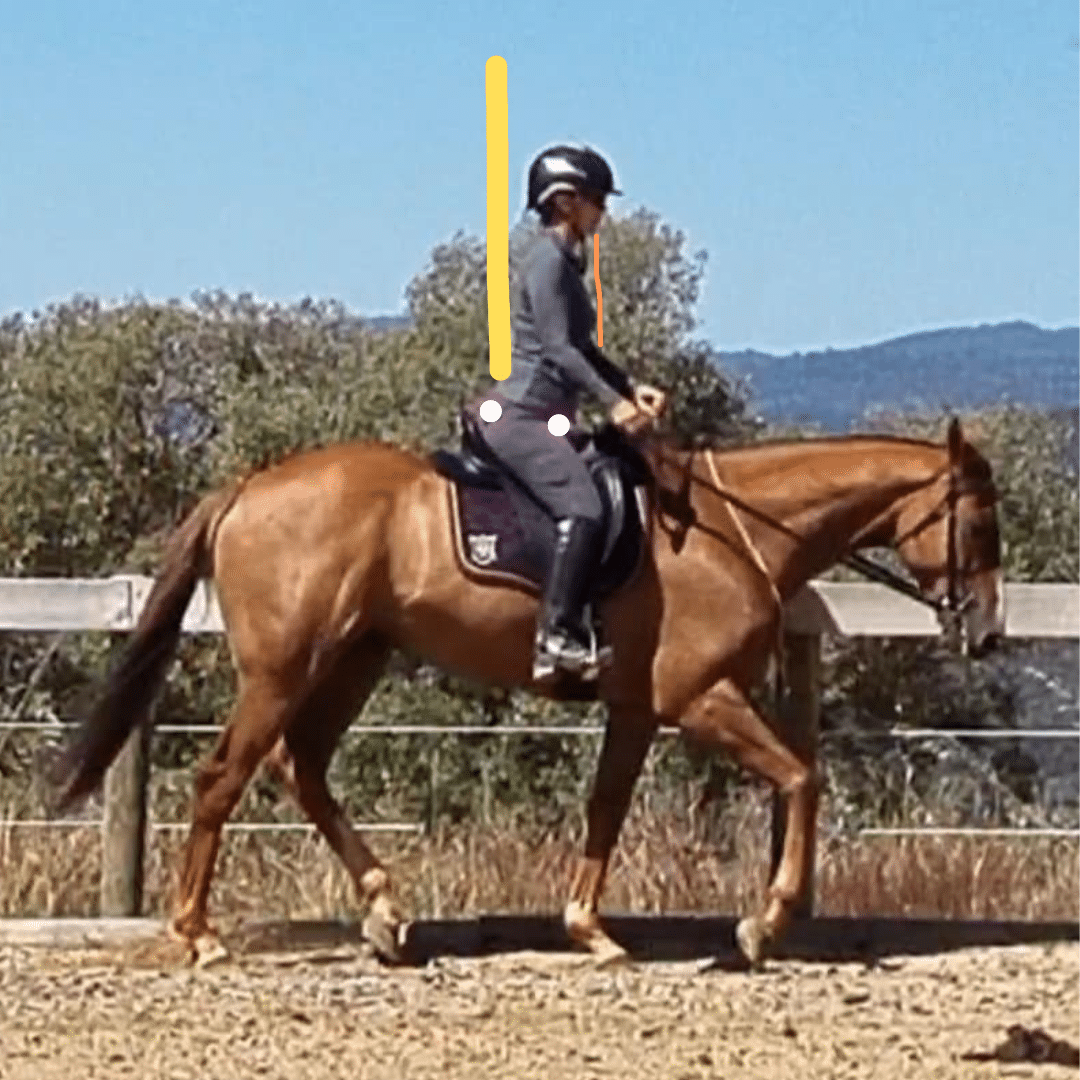
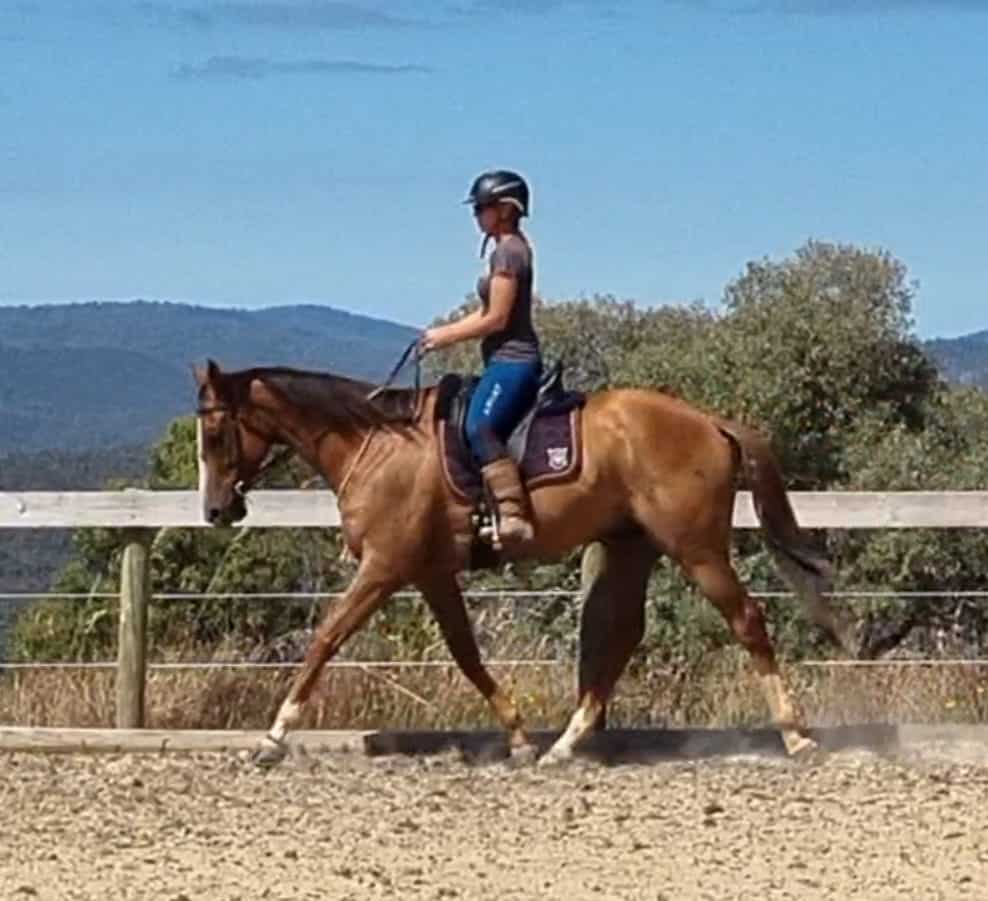
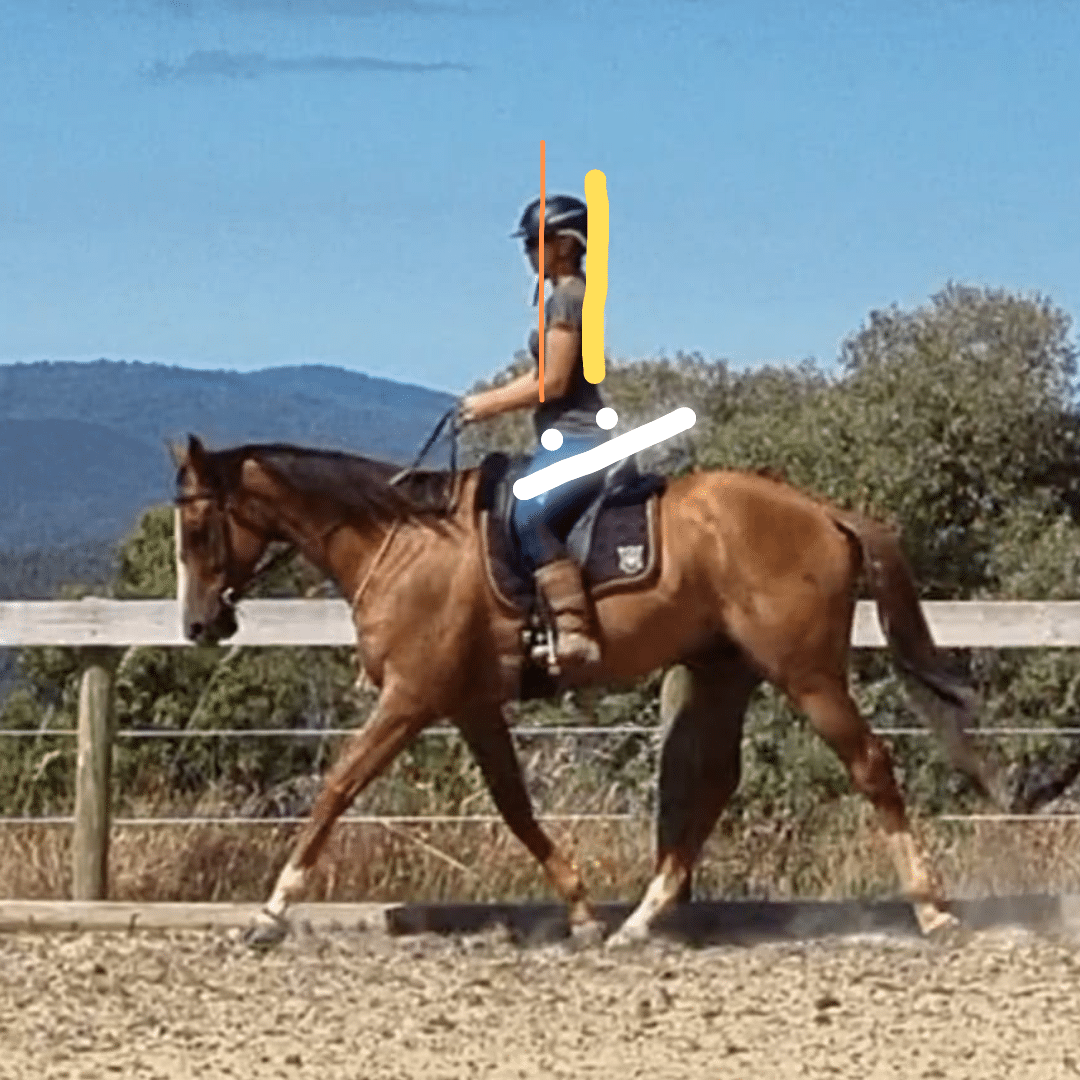
Bridget is in my program and has been doing a joint mentoring program I’ve been running with Kate Sandel. She identifies with the “anterior pelvic tilt” and as part of her work the last couple of weeks, we have been working on the following:

– The position of her heart and hyoid, by sensing the hearts relationship to the manubrium and noticing the angle of her jaw in relationship to the ground

– Changing/ sensing her rib angle so that her shoulder girdle can lift up off of the ribs and change the force output through the pelvis, allowing the centreline to begin to move, the pelvis to untuck and the lumbar spine to move back out of the tube of the body

– Working with her movement arcs and balance lines at both walk and trot

If I had had her press down through her sit-bones and tail, she would have created more compression and force through both her body and her horses (and more pain and wearing long term as a result).

More detailed descriptions on the photos. Thank you so much Bridget for letting me share these!

❤️ Jane

Photo One {Before}

Week One with Markers

Here, Bridget is in a more pronounced posterior tilt or tuck of the pelvis. It appears to be anteriorly tilted to the eye, but structurally, the pelvis is actually more tucked.

We know this for a few different reasons:

– The line between the PSIS and ASIS is more flat. In parasympathetic, or “neutral”, this line is actually quite steep, from PSIS at the back to ASIS at the front. The more flat line indicates the tucking of the tail under, despite this being what many would call a forward tilting pelvis.

– The Ribs are behind the head here or the occiput, another indicator of the pelvic tuck. If Bridget were given the instruction to tuck her tail, she may “feel” better (she would have more leverage and be more “fixed”) but she would be compressing her structure even more, and not riding with a seat that was balanced and adaptable.

– As the cervical spine gets pushed forward, the chin is now our of relationship with the breastbone

– If the ribs and torso were allowed to assume the position in line with the pelvis, it would be impossible to be upright. The lumbar spine then needs to move in which changes:

– Intestine orientation at the front of the body
– Glute position

… meaning there’s more tissue in front and behind, giving the impression of the pelvis being tilted forward.

The drawing in of the ASIS also creates more bulk of tissue on the thighs

Photo 2- After


Week Two With Markers:

– Here, the position of the ASIS to PSIS has changed, and the angle has become steeper, showing the untucking of the pelvis

– The ribs are now relating to the head and occiput and aren’t so far out behind the body

– Chin/ head/ manubrium relationship are more established


Circling, Cornering & Motorcycling Through Turns

I teach something called movement arcs or balance lines, which is all about learning how our horse’s centreline and back line move in space so we can best coordinate with their centre of balance when riding.

I love working and riding in this way because it allows me to focus on the body as a cohesive whole. The centreline is the one of the key organizing structures that the rest of the body organizes itself around; when I focus on centreline placement, the rest of my body can arrange itself so that no one part of it is compromised and compressed, and the entire structure remains open.

This is different from thinking about putting more weight down through one sitbone (for example) or more heavily weighting one foot, which compartmentalizes our focus and more often than not leads us into a pattern of micromanagement with the body from a conscious perspective, and one side being more “open” and one side being more “collapsed”.

Naturally, horses have their own patterns in their body, but I’m constantly blown away by just how influential we are as riders, and how subtle changes can make a massive difference. Horses, wherever possible, follow our balance. It’s just easier to. And for the most part, we have developed structural patterns where our centreline (a literal line that runs up the front of the body formed of the superficial and deep front line fascial trains) is fixed to one side or another and does not change its orientation in movement, forcing our horses into patterns of compensation to pick up the slack for us.

This week in JoyRide, we are focusing on riding a circle. This requires firstly understanding how our horse’s balance line moves on a circle, and then moving our centreline to match theirs. Moving our centreline requires a few things to be possible:


  1. The rib cage needs to be able to move independently of the centreline. Often they are moving as a block, which results in flaring of the ribs and leveraging through the lumbar spine.
  2. Moving the centreline is different from moving the entire torso. In fact, the tube of the body (everything you can touch) remains quite stable but the centreline becomes more mobile. It’s a fascial train and internal structural movement, rather than an outer body manipulation.
  3. The shoulder girdle needs to be sufficiently up off the rib cage and the abdominal wall stable enough for centreline to move


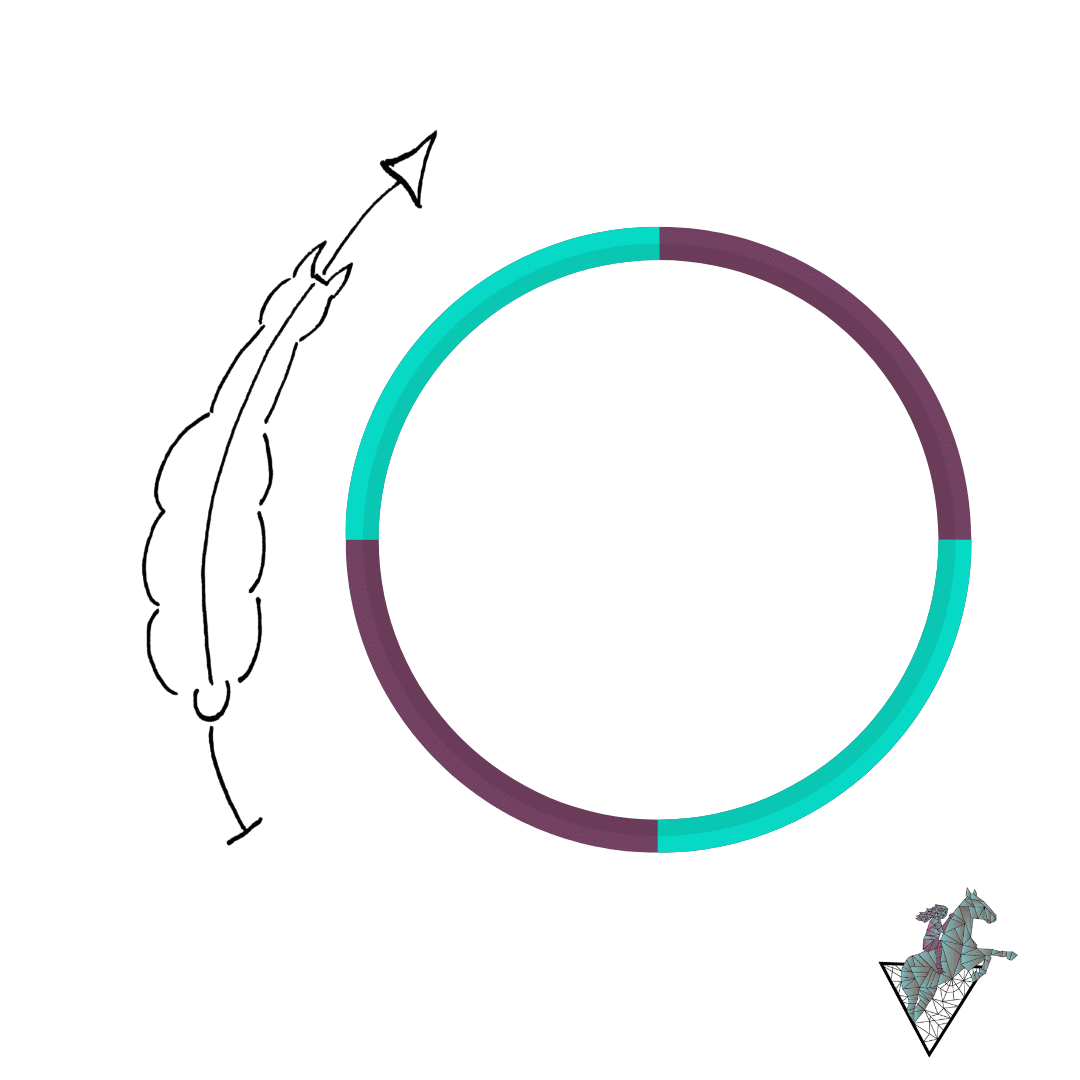
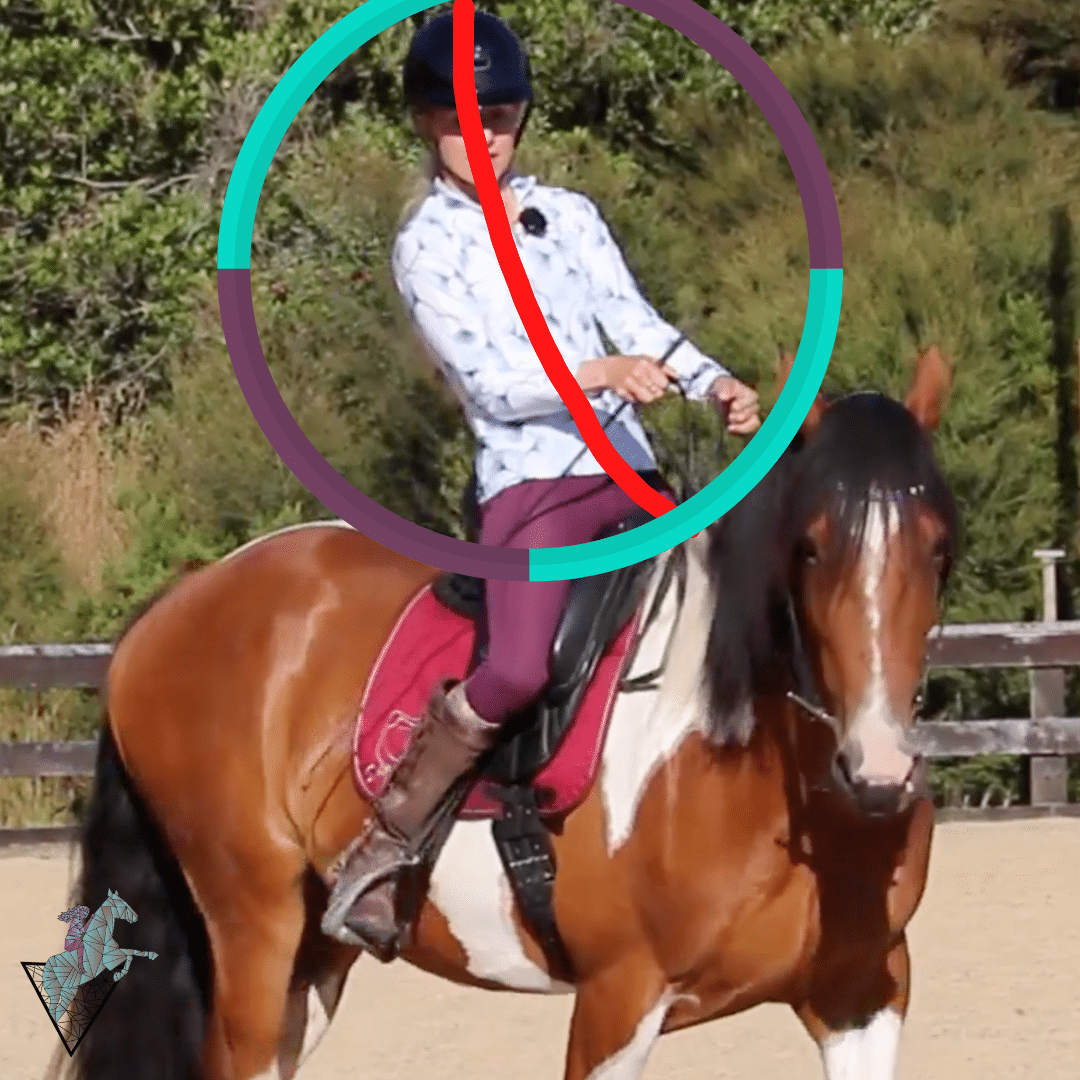
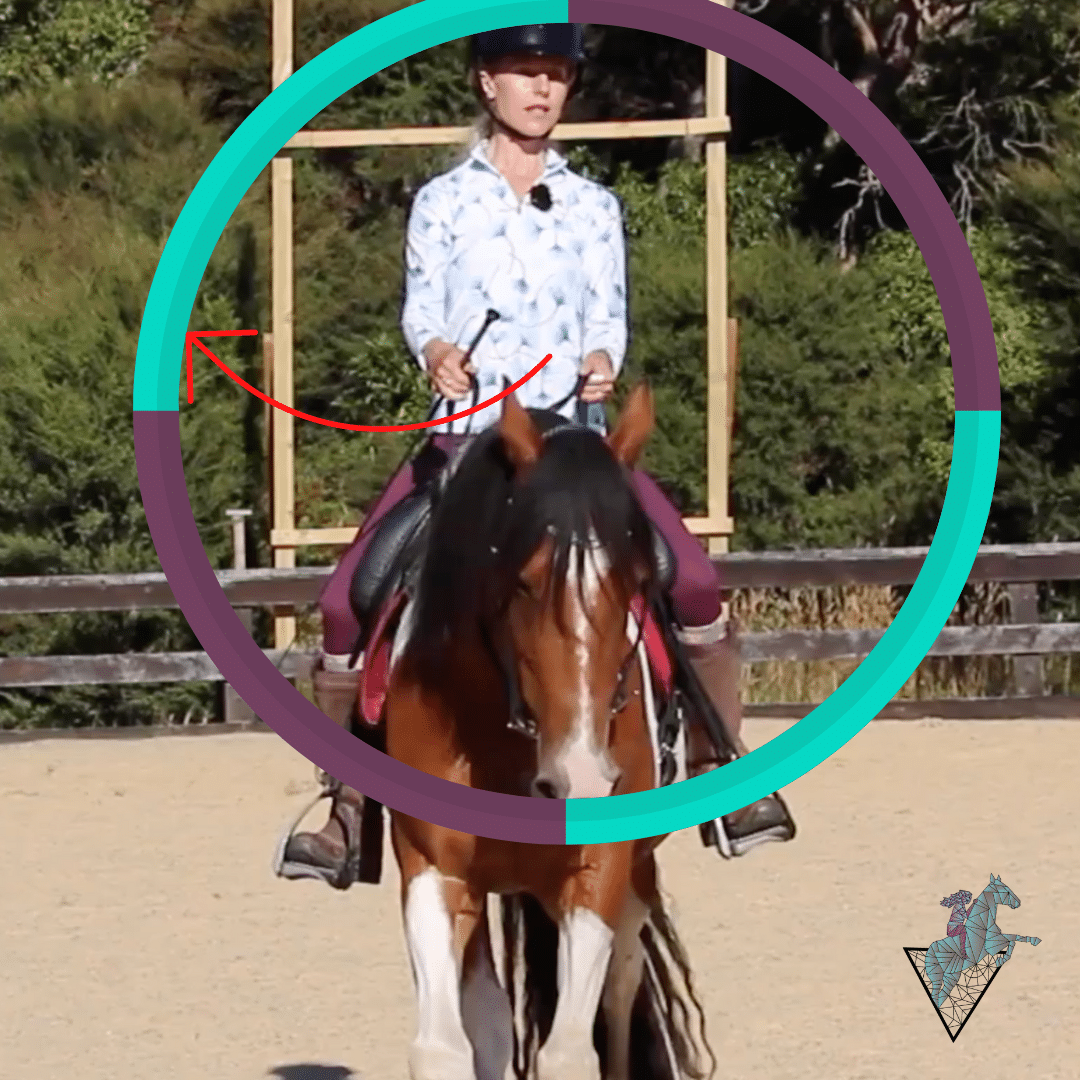
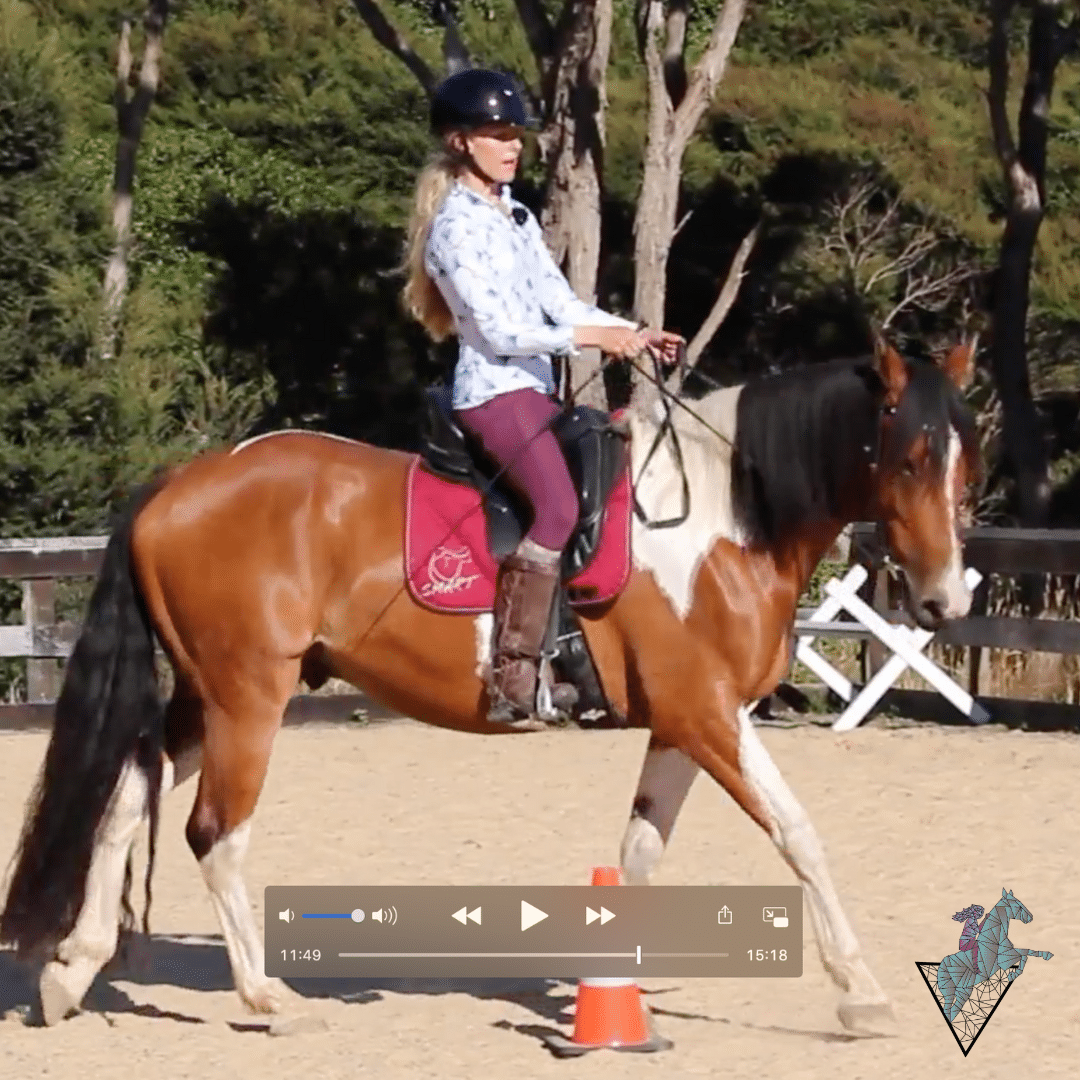
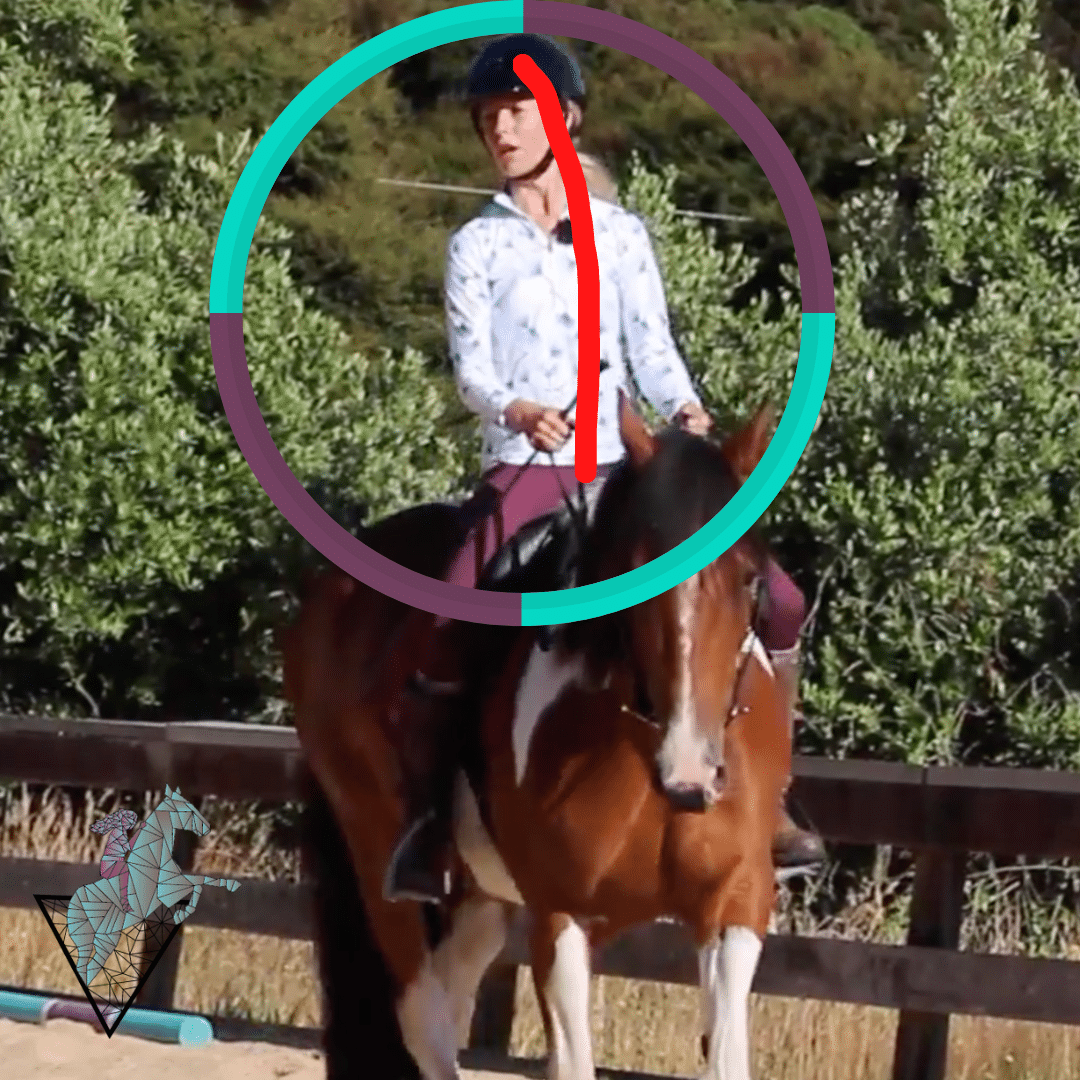
I use the visual of hula hoop arcs to demonstrate functional movement patterns in the body. It’s easier to explain visually so I’ve added descriptions under each of the photos that I screenshot off a video I made.

We are exploring this in my membership at the moment, and over the next month are looking at the balance lines of walk, trot and canter. Click here to join us! 

❤️ Jane

1. In this image, the horse is circling right. Contrary to what most people’s first guess would be, the centreline shifts left. Most riders do not make the same shift, and the centreline stays oriented to the inside. This causes the inside shoulder girdle, limb and foot to no longer be moving on the same plane, and the inside foot lands closer to midline to compensate for our weight to the inside, causing the shoulder to “fall in”.


2. In this screenshot, my centreline is moving in coordination with Mercs. He is circling left and we are filling up the arc to the right.


3. I’m exaggerating (but then you do actually see this happen!) what can be happening when someone says that the horse “won’t get off the leg”. Here, my centreline is opposing Mercs; he is following my centreline of balance as a result, but I’m asking him with my leg to move against it. He is following what my body and balance is asking, but my leg is asking something different. Very conflicting messages that horse’s often get punished for.


4. Here, our centre of balance are travelling together and we are filling up the same hula hoop arc.


5. Centre of balance travelling together


6. Here, I’m demonstrating taking the top of my centreline is out of sync with the bottom, causing misalignment and weight dumping. The bottom of my centreline from the pubic symphysis to belly button is more organised, but the top is completely out of line. You commonly see this when riders literally “look where they’re going” but fail to do so keeping in balance with their horse.

Further Musing On Tailbone Tucking

One of the things I find challenging about talking about biomechanics from the perspective that I teach it is that it’s somewhat of a paradigm shift from the way we are used to thinking about the body and how it is we sit in the saddle.

The thing about the pelvis as a structure (and beyond that, the body generally) is that the entire structure of the pelvis changes between the parasympathetic and sympathetic nervous system. Like I mentioned in the previous post, in our sympathetic or fight/flight nervous system, both the crest of the pelvis and the underside rim fold in towards midline, changing the orientation of the structures that are a part of it.

The entire pelvis narrows both in width and length. It’s interesting as the pelvis starts to change its position out of fight flight, you will feel less soft tissue around the bony structures (and this occurs regardless of how much weight you carry), as the bones of the body sit closer to the outer tube. The same is true for all the bony structures of the body.

As we move through the sympathetic reflex chain, one of the first structural changes is that the pelvis starts to tuck and curl under; the musculature and soft tissue of the pelvic floor pulls in and up, the tail curls and the pelvic triangle (of which the sit bones are a part) shifts forward.

Anytime we mimic the sympathetic reflex pattern of the body by consciously assuming these positions- regardless of our start point- we trigger the same sympathetic response to occur if the brain were to choose it organically. So if we continue on with the conversation of tucking the tail, the tucking of the tail is part of the sympathetic chain of reflexes, beginning at the fight response.

The hallmarks of sympathetic physiology is:

– Joint space decreasing

– Line of pull of muscles changing to make some more available and some less available

– Forcible change to the structure that opposes how the brain chooses to position the body at any one moment in time

It doesn’t matter what you consider your start point to be, tucking the tail or sitting back on your seat pockets mimics the sympathetic reflex response of the body, and results in a physiological consequence (the triggering of your fight flight nervous system).

The natural questions then arise, well, if tucking the tail isn’t the right thing to do, then should we poke our tail out behind?

Or how it is we should position ourselves if tucking the tail under isn’t it?

And again, this loops me back around to it being somewhat of a paradigm shift to consider things from this perspective.

We love to control and change the body according to outer appearances. Most of us consider these conversations from the point of view of outward postural aesthetic, rather than considering how the internal structures are moving and articulating.

Secondly, we love to think in opposites. Well, we say, if it’s down, this may need to go up, or vice versa. But in reality, it doesn’t work that way.

If your brain has chosen for your pelvis to be positioned in a certain way, altering the tube of the body to be different (by moving in the opposite way) doesn’t change how your internal structures are articulating; it just causes compression and compensation on another part of the body.

If you understand your pelvis to be either posteriorly or anteriorly tilted (and this is a conversation for another day but let’s play with it for a moment), then your pelvis is operating with a sympathetic movement or motor pattern. In order for that to change, the neurological template needs to change.

It’s not a matter of forcibly opposing the tilt or counterbalancing it through tightening this or releasing that, or weighting this or unweighting that.

Instead, it’s the entire pelvic bowl opening and widening; it’s the fascial trains hydrating and the pelvis floor releasing to allow for independent left right movement of the pelvis; it’s the shoulder girdle being lifted up of the rib cage to minimise the force output through the pelvis. It’s all of these things.

Why I singled out the tail in this morning’s blog is because it’s an excellent example of how we can mimic a fight flight reflex in the body. And to move out of that isn’t as simple as just “doing the opposite”. It’s a matter of the entire body widening and opening from a structural perspective, which requires a different approach to what we might typically be used to.

A paradigm shift.

Onwards.

❤️ Jane


Tucking Your Tail {And Other Misadventures That Fire Off Your Fight Flight Nervous System}

I read an article recently that was addressing fear in riders, and the tendency that many of us have to curl up in a fetal position or clamp down in front when we get worried or scared. Along with the discussion, it talked about the psoas muscle and how the psoas muscle acts to essentially close the hip angle as part of the fear response.

The antidote it offered was to press your buttcrack down into the saddle and engage your abs, an action the author said opens and relaxes the front of the hips, counterbalances the action of the psoas muscle and by default increases your confidence.

I’m interested in writing about this because I’ve seen it referenced on multiple occasions but also the information that it highlights is shared and practiced by many riders I have the honour of working with.

So, let’s break it down…

All muscles have something called a line of pull. The line of pull refers to the positioning that the actin and myosin fibers needs to be positioned in so that the muscles can essentially contract and release. For instance, if the fibers are too far apart, the muscle is not very functional. Similarly, if the muscles fibers overlap too much, its function is compromised.

The way that our muscles are recruited is different between the parasympathetic and sympathetic nervous system states, and consequently the line of pull changes. In the sympathetic system, the priority is to maximise our forces of speed, force and acceleration. As a result, some muscles are turned on and some muscles are turned waaay down.

This change is muscle function and availability are informed by structural changes in the body. One of the first things that happens in when the sympathetic reflex system is activated is that the tail tucks and the pelvis tilts posteriorly.

The tilt of the bony structure of the pelvis occurs to trap blood in the legs, but more relevant to this conversation, the line of pull of the psoas muscle is changed. The psoas muscle travels from the lumbar spine, over the front of the pelvis to the lesser trochanter, at the top of the femur. So instead of running vertically up and down in the parasympathetic system, as we move into fight flight, the pelvis changes its angle to be back and up, meaning that the position of the psoas muscle changes also; the muscle literally has a longer distance to “travel” to maintain its position from point A to point B.

We may “complain” about tight psoas muscles and look to “stretch” them, but the start point to the “issue” is that your pelvis is tilted backwards. Your psoas muscles are pretty much just experiencing the side effects of that.

Now on to your butt crack and tail. The top of your tail is where the top of your butt crack is, and the entire tail is about the length of your thumb. Most adults in our society are so sympathetically dominant (so living out of their fight flight nervous system) that the top of the tail is well under the body. In ideal circumstances, when we sit down the top of the tail will be that same distance up off the floor (like in the photo of the baby sitting on the floor). But back to the article…

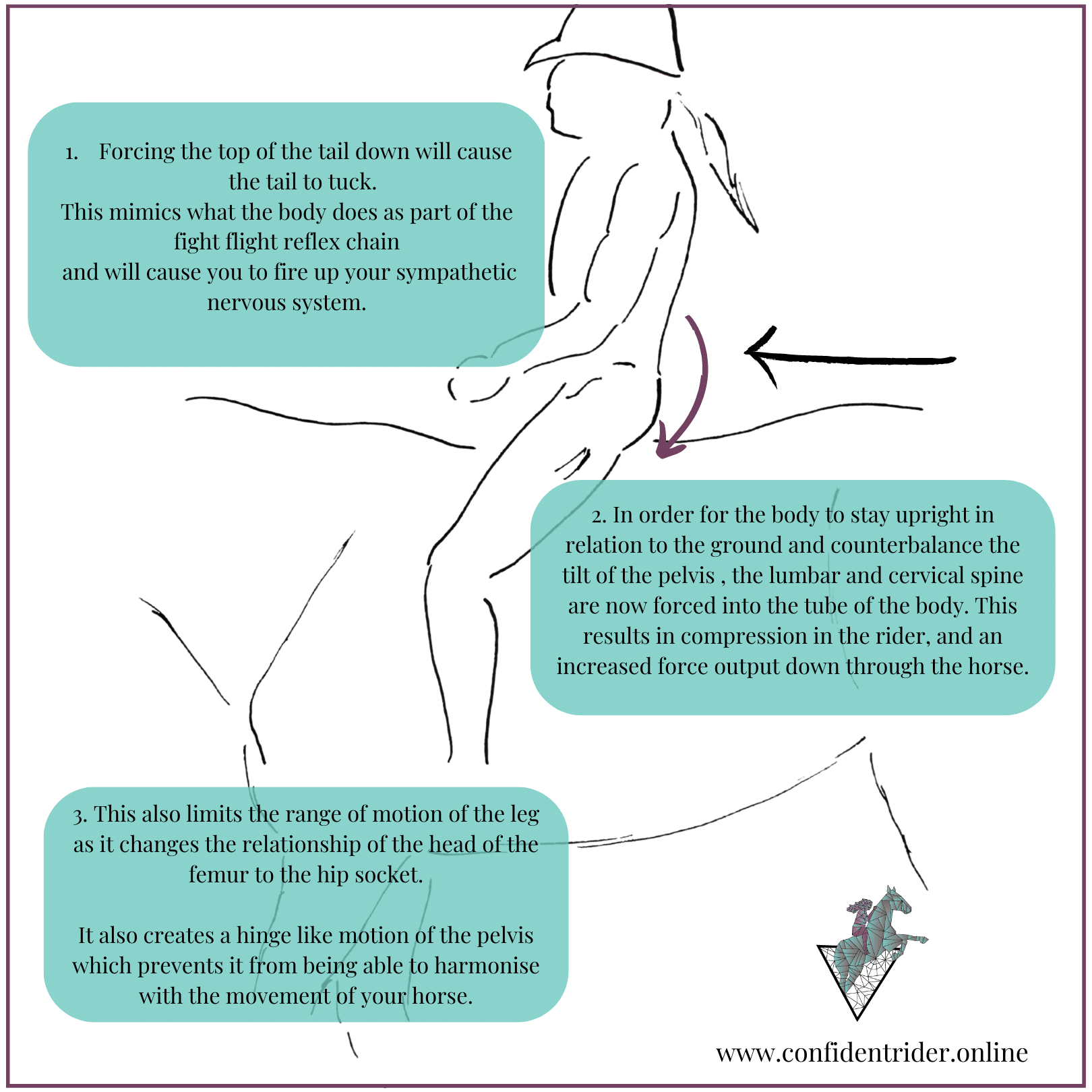
Sitting or ramming your tail down does not change the position of your pelvis or psoas muscle to make them more open. It’s a physical impossibility. All it actually does is drive you further into a fight flight position. Tightening the abs does the same.

And while we’re here, we might as well talk about the sit bones.

The sit bones get a lot of airtime when it comes to position and balance, and almost all of the instruction that I’ve heard involves positioning your weight directly on and evenly between your sit bones.

If we zoom out for a moment, the entire pelvic bowl changes its position from sympathetic to parasympathetic. In our sympathetic or fight/flight nervous system, both the crest of the pelvis and the underside rim fold in towards midline, changing the orientation of the structures that are a part of it. One of the first things to happen, as we’ve mentioned, is that the pelvis starts to tuck; the musculature and soft tissue of the pelvic floor pulls in and up, the tail curls and the pelvic triangle (of which the sit bones are a part) shifts forward.

Most of our instruction around position and balance assume a tuck of the pelvis. They assume that to be sitting on top of the sit bones is the norm, and in some ways, it has become so. To be functioning dominantly from the sympathetic nervous system has become a hallmark of modern living- but that still doesn’t cancel out the fact that a whole different sense of possibility exists.

In “normal” or parasympathetic functioning, we are designed to be sitting on the long, flat ramus bones that lie between the sit bones at the back and the pubic tubercles on the front. All of these structures sit behind the legs, allowing for both the hamstrings and the adductor muscles to maintain their homeostatic length. In other words, it allows them to move and the fascia to slide without being crammed and jammed up as a consequence of the pelvic tilt.

If you look again at the photos of the baby, this is a beautiful example of parasympathetic posture (the drawing has the pelvis still in a slight tuck). A good marker to train your eye to is the top of the tail, which is where your butt crack starts. You can see how high the tail is here, allowing the sit bones to sit facing to the back diagonal (rather than underneath).

If you sit on the floor with your legs outstretched, notice how high your butt crack is off the ground. For the majority, it’s very close or underneath us. This gives us information of the nature of our own pelvic tuck and the resulting structures.

This drawing is mine (I’m not an artist as evidenced here!) but I wanted to show you some of the consequences of forcing the tail into this position.


I get how when we are afraid or recognize that our body is moving in some funky ways that we search for quick fixes that can “counteract” the way that our body is choosing to move And there are things that we can do (they just take a little longer to practice)…

Jamming your tail down and pulling your belly in will give you leverage, that’s for sure. But as if we’re looking for harmony and balance, it’s not the way forward. Just sayin’.

Onwards.

♥️ Jane

Scoliosis, Asymmetry & The Flee Pattern

In my experience working with the nervous system and the body, most presentations of scoliosis aren’t congenital and irreversible (so something you are born with and can’t change) but a result of the nervous system being “stuck” on particular channel. In the case of scoliosis, what’s expressing is a neurological flight pattern where the body is trying to either exit stage left or exit stage right, depending on its dominant expression.⁠

⁠If we consider how the structure of the body expresses in flight, there are a standout features to take note of:⁠

👉 Rotation of the upper body or spine, with one shoulder blade sitting closer towards the spine and one further away⁠

👉 “Uneven” pelvis, with one foot pointing more out to the side than the other⁠

👉 Elbows will typically face out, with the palms of the hands facing the inside of the elbows⁠

The purpose of the brain in flight is (obviously) to flee. I have seen instances where someone who first presents with a flee pattern right will shift to a flee pattern left, depending on where their significant other was sitting in the room. You don’t have to be a mindreader to know how things are going in their relationship.⁠

When you start to be able to read structure, you can observe when someone’s flee pattern is active as the structure of their body will reflect their desire to leave.⁠

In someone who presents with this pattern being the “norm” that gives us information that at this particular moment in time, either their body is reflecting the truth of the situation (and they do, indeed, want to be somewhere else) or their nervous system lacks adaptability and has got “stuck” on the flee response.⁠

In my work, I’ve seen numerous examples of people “arriving” with a flee pattern that has been with them for decades that they’ve watched slowly unravel as their nervous system became more adaptable. The body always seeks harmony- sometimes it just doesn’t have the information that it needs. ⁠

So what is the “fix”?⁠

With the approach I work with, we understand the way that our body is positioned and our biomechanics as being ultimate informed by our autonomic nervous system, which is under our unconscious control. What this means is that we can’t “force” the body out of this place; it has to be the decision of our unconscious brain.

More sensory information is what the brain requires in order to make different decisions, structurally, emotionally and behaviourally. The movement work I teach is about activating the sensory feedback loops in the body (loops which go offline when we spend more time in our sympathetic nervous system than out of it) to give the unconscious brain more information, and to update its body maps. In this way, the brain releases its old patterns and creates new ways of functioning and movement that are more relevant to the present moment.

This conversation was motivated by a question posted on another thread of mine that talked about scoliosis and asymmetry, and so I also wanted to make the distinction between those two things. While we have talked about scoliosis being a flight pattern, asymmetry relates more to a lack of movement in both the superficial front line and deep front line fascial trains (both of which form the centreline of the body). In this case, the centreline is more fixed to one side, which again creates a lack of adaptability in movement but with a slightly different manifestation.

Riders will commonly experience this as a heavier weighting of one side of the pelvis over the other and a distinct difference in comfort and “ability to ride” depending on which direction they are going.

Scoliosis has more of a rotational component than what we might see with “straight” asymmetry.

And on that note, if your interest in position and biomechanics isn’t incorporating the nervous system, you are always going to have limited “success” in changing things up, simply because it’s the foundation that everything springs from.

It really is an inside out job.

Onwards.

♥️ Jane

On Grief.

A few days ago, I wrote how I lost my precious yearling Bear. Since that time, I have adventured through the depths of my own grief to see if I might find a jewell at the bottom of what can seem like a very dark well.

For a while now, it’s been obvious to me how little we discuss death and dying in my culture. How “bad” we are at it.

And so in some small way, I wanted to share my thoughts in an attempt to swim against that tide. And in the hope that in doing so, I could more easily touch on the beauty wrapped up in the loss.

The following are recordings of two live videos I recorded on Facebook; the first the day after my horse passed away, and the second a couple of days after that.

It is my hope that in some small way, they will help someone going through the own grief and allow us to, as individuals, start to include death in the conversation that is life.

Much love,

❤️ Jane

Video One: Some Imperfect Thoughts On Grief

{You can also find this video on Facebook– the comments may help you feel less alone on this journey}

Video Two: 

Let’s start with…

  1. Thank you
  2. What’s the invitation?
  3. Restoring vitality as an act of everyday activism

{Link to video on Facebook if reading the comments are of interest}

Tending To Your Own Vitality With Fierce Dedication Is A Form Of Everyday Activism

The word vitality stems from beautiful origins. It’s born from the latin word “vitalis”, which translates to “of or manifesting life” or “belonging to life”.

As part of our birthright, all of us hold the vibration of a vital essence. If we described someone as full of vitality, what is it we see?

We see the visible flow of life moving through them, making itself known as energy, passion, a vibrancy of spirit, both physically, mentally, and spiritually.

We see evidence of their heart smiling on the surface of their skin.

They seem… alive. Which, by default means when we lack vitality, we lack aliveness.

When we are vital, as the origin of the word suggest, we recognize we are of life, and creating life all at the same time. We recognize our connection.

We understand ourselves to be both created- of the world and connected to it- and creative- having the capacity to birth ideas and to grow and nurture them.

A system with vitality is a system that is adaptable. It has energy to expend because doing so does not lead to depletion. The resources are there to be used.

Which is why, tending to your strong and gentle self- physically, mentally, and emotionally- and following the things that you love…. These things need to be your highest priority.

Without a sense of your own vitality, you cannot be present in situations that require more of you.

You cannot be part of bigger global conversations.

And you cannot be a part of conversations with people or things you love who require strength and support.

Which is why tending to your own vitality is an action of everyday activism.

Tending to your own vitality gifts you with the capacity to be present in the midst of discomfort.

It allows to be able to turn towards it, instead of away from it.

It allows you to tend to what you love in order that you see and experience more of it.

If you haven’t been taking your own wellbeing seriously, now is the time to start.

Onwards.

♥️ Jane


We Have Many Allies In The World Beyond The Human

What if, whenever we felt lonely, what we were actually experiencing was a state of mis-attention.

Where our mind had pulled us inward and convinced us that we are alone in this experience.

Alone in this grief.

Alone in this conversation we are having.

Alone in this challenge that we are attempting to navigate our way through.

And what if loneliness was indeed a state of missing, but the not the kind of missing we might think.

The kind of missing we first think of is the missing out kind…

The missing of company.

The missing of friendships.

The missing of intimacy.

The missing out of being included.

I’ve been taught to understand loneliness as an invitation to pay fierce attention to my natural allies in the world.

And to seek them out.

They are

My horses in the paddock

The leaves on the trees

The ground beneath my feet

The sky above my head

The birds I hear in the distance

And paying attention to those things, takes me the 1/3 of the step, the ½ a step beyond my current self

To have a better idea about what the next ½ step might look like.

Anne Lamott said: “I see my mind as a dangerous neighbourhood. I never want to go there alone”

Not going there alone, as David Whyte says, means going in with perspective.

And the perspective I want to offer here, through the understandings he has taught me, is that we have many allies in the natural world beyond what we might think.

At all times, and in all circumstances.

Waiting to befriend us

if only we allow them too.

Onwards.

❤️ Jane

End notes: I’ve had many conversations over the last year with people feeling lonely.

I offer the above not as a substitute for human company or connection, but as the start point to acknowledge that wherever you are, you already have “natural allies and friends”, again, in the words of David Whyte.

And as with everything, we must start where we are.


I’ll See You Up The Mountain.

Where do you go, I was asked, when you need to unwind, or recharge?

Where do you go to reconnect with the world?

Ahh, I told them. I have a place. First, I make my way up a stony path. It starts at my house and winds its way through the manuka trees until I reach the top of the hill. The path changes then. It’s full of ferns and gums, and there are springs that run little rivers under my feet, causing the ground to splash up around me.

There’s a gate at the bottom, with a trough to one side. I push it open and walk in. And in there, along with my glorious paint horse, I find my little Irish pony Bear. He’s only one year old. He sees me. And every time, he comes, and he asks for his beautiful head to be held in my arms, and I take it.

I stroke his eyes and tell him how much I love him, how grateful I am for him.

Of every horse I’ve ever owned, Bear loves hugs. He loves hugs in a way that causes you to lose sight of what’s your body and what’s his.

Where you lose your face in his fur, and where his kind eyes like pools of melted chocolate make you feel like all is right with the world.

In that same paddock, I tell them, with my paint horse and my Irish pony, there is a big log. It’s so big that if you sit behind it, no one can see that you are there.

And I go to sit, and my little big Irish pony sits with me, and we put the world to rights.

And I’m reminded that when the world created kindness, they poured it into Bear. I feel his emanations going through me, bouncing off me.

Yesterday, I lost Bear.

For 24 hours, he was very ill. And in the same time, I held his head and I told him that I loved him and that I was proud of him.

I reminded him of our log. And I hoped that in even a tiny way, I could give him a glimmer of the comfort and love he had poured into me over his short but mighty life.

I tried to love him to life, even when I could see him slipping away.

I told him, Bear. I want to adventure through the mountains and rivers with you. I want for you to be here so I can love on you.

But it can be in this life or the next. And if you choose the next one, I will meet you there.

Bear chose the next one.

I want to say I lost a piece of my heart yesterday. That’s how it feels. But I think in reality, it grew bigger. That now my little place with Bear behind the log is not a place without, but a place within.

I won’t be the same for loving you. But I guess I’m not meant to be.

I do love you, my little Irish pony. I miss you so hard.

You were all things good in the world.

I’ll see you up the mountain.


Your Body Is A Portal For Your Intuition

It’s 2004. I’m in Sri Lanka, two weeks after a devastating Tsunami swept through. I’m here as an aid worker. The hotel I’m staying in is right on the beach. I watch the waves out of my window. Lightening doesn’t strike twice, I say to myself, a mantra that feels hollow when chanted over a pile of rubble.

Many times, a day I hear the shriek of villagers yelling Tsunami! Tsunami! This village, full of generations of fisherman and people of the sea, are now afraid of the waters that for so long have sustained them.

They are sure a second wave is coming.

I nod at their warnings, but the truth is, I’ve stopped caring. I’m exhausted.

At 1am, I hear a bashing on my door.

Madam! Madam! Tsunami! Tsunami!

It is my friend and compadre in Sri Lankan adventure, Aruna. He has left his family, come down from his home in the dense jungle trees to get me.

I’m grateful but again, exhausted. I wonder for a moment what it would be like to swept up in the wave. Maybe then I could sleep? I think.

I snap myself out of it. I climb in next to Aruna.

It’s been a long haul of short nights and long days. I’ve been working with a group of children. I’ve been trying to work out what they need, beyond the expected and the practical.

I buy packets of coloured pencils and paper and offer them to them. In return, they hand me back drawing of black waves with angry faces and floating bodies. I thank them, not sure what to say.

This is so big, I think to myself.

Aruna takes me to the jungle, and they offer me their bedroom. I refuse but they insist. Aruna’s wife gives me a nightie that buttons right up to my chin, its thick cotton hanging all the way down to my feet.

It’s stifling. I wonder how this Victorian dress came to adorn a body that had no use for it.

A couple of hours later, I can’t take the heat. There’s no breeze. I’m drowning in the warmth of my own breath. I bust through the mosquito net and sit on a plastic chair, under the trees, in the middle of the Sri Lanka jungle.

The insects feast on me. I let them. I’m a different kind of tired now.

There are some states of being that invite your intuitive self forward. They are the states when you are at your most raw. When death, and life seem very finely separated. Like you can taste the difference between them.

In these states, when you lose your social niceties, you realise that you are not equal with the trees, the water, the earth, but perhaps ranked slightly below them. That you are most in touch with and most trusting of your inner voice, your internal guidance system and you follow it in these places, where the stakes are high.

Because to think too long has consequences. You just don’t linger.

I look back on the version of me that in between work trekked alone through the middle east, India, Pakistan, Nepal, and I recognize I’ve used more than the nine lives owed to me. But the irony is, when I was out there, dancing on the edge of the volcano, I had the biggest sense of self-trust. My instincts were intact.

In the cocoon of our comfortable lives, it’s often our horses that give us the biggest sense of connection to a sensory base that is our birthright and yet often feels very far away. We ask ourselves, how do we develop our intuition?

As though we aren’t intuitive beings to begin with. So far removed we have become.

When I first started studying anatomy, physiology and the nervous system, it felt so reductive. It felt as though the mystery and magic of being human had been reduced to bones and muscles and fascia and a pile of red blood cells.

But the more I learned, the more I understood. Our body and our nervous system are a portal to access our intuition. In a world where we no longer run as hunter gatherers, but instead our bodies have been units of production in a capitalized, colonized world, we need tools to find our way back.

I understand now that my body, your body, is the way back.

I get asked often, how do I trust myself? How do I develop my intuition?

And the answer is, you start where you are.

You start with the knowledge that to be intuitive is who you are. You don’t need to earn it. You just accept it.

And then, the practice- or my practice- is one of the body. Of noticing, observing, of activating my sensory system so I can feel my way through the world, not think my way through.

If there are three things that get in the way of being able to hear the sound of our own intuitive voice, it is:

  • Perfectionism
  • Judging the outcome
  • Attempting to control

Instead, we simply decide. We take an action. We see how that action lined up with our intention- with no judgement. And then we repeat.

You are intuitive. That’s never been in question. What you need to look at is everything that caused you to think that wasn’t the case.

Onwards.

❤️ Jane

If Your World Is Rapidly Expanding Sideways, Keep Focused On The Up & Down

There’s a moment when you get off the plane in New Zealand and start to make your way through the airport that a waiata plays across the speakers. It could be kitch but for some reason to me, the song lands straight in my heart.

You walk a few more steps and now, the sound of bird song. At this point, I close my eyes. My feet keep moving and I pull what is probably far too many bags along with me, imagining myself lying flush against the earth, within a mossy greenness that only Aotearoa can provide, staring up at the sky, slowly, gratefully getting swallowed by nature.

I was born in Australia and left in my late teens. I am more kiwi than Australian, despite the red dust and the smell of eucalypt being imprinted on my heart, but at my core, am yet to find the place where I feel my feet have permanently landed. I feel a strange mix of an eternal, restless nomad, and a staunch homebody, two opposing energies which for a long time caused me to feel ungrounded in the world I was a part.

Conventional life is something I always struggled with. And so, my quest has been to find a steadiness within that could anchor me to an everchanging scenery without, with varying degrees of success.

This last two weeks I’ve been part of something beautiful and big. After an extended period- years- of working alone, of study and of teaching, the universe plucked me out by my shirt tag and placed me in a vortex of learning, conversation, and inspiration whose seductive, collective energy you never want to end.

But of course, it does.

And so, then the adventure becomes, how do you take the energy of what has been and reconfigure? How DO you shapeshift?

Those of you at the summit with me will understand what I’m talking about. But this is not some secret club, or exclusive membership to which others are not privy. All of us have had this experience, be it at a clinic, a holiday, a learning experience of some kind, or even a loss where your cells get shaken up and when they settle, the pattern was different to what it was before.

It’s destabilizing because it should be. A life well lived is a life of curve balls and disruptive energies. Experiences that cause you to question and think and wonder and ultimately, change. To evolve.

But it’s these qualities that are also the hardest to hold. They call things into question, and to change, and you can be left with a feeling of discontent. They can make you feel a little crazy if your bodily container is yet to figure out how to embrace them.

I had some words spoken to me just yesterday by a very dear friend and mentor that I wanted to share with you now. She said, your container is expanding fast, Jane. With every conversation and interaction, it’s getting bigger and bigger.

As she spoke to, she held her hands in front of me and began to move them out to the side, as though holding a beach ball within them that was expanding every second.

Your work then, she said, is to focus on this energy. She took her hand and traced from her head, down the centre of her body to the ground.

The expansion is occurring. Your work is to stay connected and grounded within it.

The purpose of this writing is ultimately to share what staying grounded and connected looks like to me in the midst of rapid change. Or perhaps moreso, what it doesn’t look like.

It doesn’t look like comfort.

It doesn’t look like calm.

It doesn’t look like clarity, even.

What it does look like is openness.

It looks like gratitude.

And it looks like waiting for the spinning ideas and possibilities to land in a way that informs my next right step.

In the midst of new ideas, conversation and possibility, you don’t have to force what comes next. Your only job is to be with it. To be open to it.

And then within that, to stay present in your life. To keep moving. Literally and metaphorically.

To get your toes in the earth, whenever you can.

To be with your horses if you are fortunate enough to have the opportunity to do so.

And to be ready. For whatever the greater world has planned for you next.

If your world is rapidly expanding sideways, keep focused on the up and down.

Onwards.

❤️ Jane

Beginning With Brilliance

Yesterday, I slipped out into the afternoon sun, grabbed a halter and walked up the farm to get Saffy out of the paddock. I had planned for working longer, but the still warm day seduced me, and it seemed that there was no better time to be spent than outside with a horse.

With their rugs off in the first day of the spring sun, Saffy stood in her rich redness and I sidled up to have a conversation. For the best part of a year, we have done little together by way of formal work. Much of what we might have considered to be “challenges” together have self-resolved; or rather resolved without intervention on my part.

Her fellow horsey friends have taught her about order and manners and our daily interactions of rugs on, rugs off, may I check your feet, may I brush your mane, can I give you a snuggle, have afforded us a level of trust that makes our dealings together smoother when more is asked or required.

Saffy is a red mare. She’s smart, focused, and athletic. She likes to be asked to do something in a manner that understands the queen that she is. She can take care of herself and does not suffer fools.

If she’s in the paddock, she’s the first to march ahead if something new or unusual is introduced. She’s brave. A horse you could see would stand in front of her people and look out for them.

I love that about her.

Given her limited experience in the world of training for Wot-humans-want, she is brilliant. Quick to learn, quick to understand and quick to apply.

As I send her out on the line, I love that the platform we begin from is in reverence of that.

You are so smart, Saffy, I tell her. You are brilliant.

I’m overwhelmed with the intelligence of horses. How they figure things out and decipher the human game of charades that we present them with.

I wonder how much better our experiences would be if we all started from that place.

If the first thing we did when we looked at our horses is thought, you are brilliant.

How smart you are.

I wanted to share that with you today.

❤️ Jane


Movement Of The Shoulder Girdle Dictates The Movement Of The Head

In parasympathetic movement patterns, the shoulder girdle- and specifically the AC joint- is what dictates the movement of the head. If you look at Image 1, this is the trapezius muscle. It attaches to the lower thoracic spine, the shoulder blades and behind the head.

If you were to look at a front image of it, you would see that it also loops over and attaches to the outer part of the collar bone.

One of the analogies we use a lot to show healthy movement patterns is that of a stingray, and if you look at the shape of the trapezius, it is very much of this shape. In movement, as the outer edges come forward, it allows the body to come into a curl.

As they come back, it facilitates the arch. In this way, the spine, head and shoulder girdle are all co-ordinating and working together to ensure no one part is compressed.

What you see commonly, however, is independent movement of the head separate to the shoulder girdle. Image 2 is an example of the shoulder girdle being rounded forward in a collapsed posture, and the head being forced upright. You can see how much pressure is then placed on the neck musculature and how it forces the thyroid cartilage (Adam’s apple) forward.

In Image 3, the head is looking down, but the shoulder girdle is fixed, again, placing a lot of pressure not only on the neck but also the spinal cord, another fight/flight motor pattern.


In functional movement, the distance between the ear hole and the AC joint will always stay the same; often, however, you see the distance getting shorter and longer as the two points move separately.

In rotation, we only have independent rotation at C1 and 2; this allows for the head to rotate at about 45 degrees (Image 4) before the shoulder girdle must go with it.

Image 5, however, shows common movement patterns where the head has moved beyond the 45-degree range, but the shoulder girdle remains fixed. This then requires each independent vertebrae in my neck to move and creates wear and tear on the spinal cord as a result.


Mobility of the fascial trains, understanding functional movement and motor repatterning not only allows the body to move in a way that’s sustainable but also avoids us firing off our fight flight nervous system through the repetition of sympathetic movement patterns.

As you ride, notice how often your head moves independent of the rest of your body. Notice when your gaze/ head turns beyond the 45-degree range. Does your ear and AC joint coordinate? Or are they working independently?

All valuable things to take note of, that have ramifications physically, but also mentally and emotionally- not to mention dramatically influence the ability for you to harmonise with your horse.

Onwards.

❤️ Jane

Social Media & Blogs Are Just A Taste Test…

Over the course of a month, I write a number of blog posts and share frequent snippets of my work on social media. I know that I am far from alone in that I’m interested in producing content of value, and that I hope is of interest to people, but at the same time there are limitations to how far you can go and how deep you can dive when the medium you are sharing on is one that whose currency is clickbait and where you’re encouraged to compete for scattered attention.

I know I’m also not alone in saying that what I write and offer via social media platforms is superficial compared to the actual work I do. It’s usually a snapshot that touches on subject matters that I’ve spent many years studying and have many conversations and practices around teaching.

I mention this because there is an expectation at times from some people that the whole answer to a challenge they are currently facing can be found within the confines of a blog or social media post. And that beyond that, that we are entitled to the time and knowledge of the person writing it if only we use enough capital letters or question marks to highlight the urgency of our requests.

I appreciate social media and for the most part have interactions that (I hope!) are mutually enjoyable and beneficial. But I’m sure I speak for more than myself- for my colleagues in various aspects and arenas of the horse world- when I say that social media can be a portal to finding people, work and ways that will assist you and your horse in finding answers to the challenges you face or to more information on areas that light you up or are passionate about. I love it for that also.

But it is not The Work.

Often times, when people email or message me, I can’t provide the answers they expect in the same format. And directing them to paid options like my membership, is not an attempt to fob them off or get them to sign up for my stuff. It’s a recognition that if their question is truly to be given the consideration and attention it deserves- and if they really want the answers they seek- then we need to invest a little further.

We need a bigger container, a bigger conversation, a longer time frame and more room to play, get curious and explore than a Facebook comment, a DM on instagram or an email will allow for.

Social media is a taste test, but it’s far from the whole meal.

Onwards.

❤️ Jane


Embracing Your Finite Time

Time- or perhaps more specifically, the feeling that I don’t have enough of it- is something that I have wrestled with my whole life. In the day to day, it manifests as not being able to do All The Things, when All The Things is, indeed, what I want to do.

From this mundane musing on daily activities, my conversation with time has, in certain moments, morphed itself into a somewhat of an existential crisis. It was my birthday last week, my son’s birthday next week, and I find myself doing sums in my head of days, weeks, years, decades and how it is I would like to fill them.

Beyond that though, the most brutal aspect of my time conundrum is the fact that I often allow myself to feel endlessly busy. The feeling of busy-ness, can if we allow it to, shapeshift to a feeling of burden, and from that place it’s easy to martyr ourselves to the system and convince ourselves that we no longer have choice.

And so, it’s based on all of this that I have grabbed myself by the shoulders, pushed myself back and taken myself on a magical mystery tour of what it means to be human. I thought I would share it with you here given there is a most excellent chance that you are human also.

Because I can’t have a conversation of any sort without weaving in the nervous system in some way, let’s start there. From a nervous system perspective, if your nervous system is adaptable and responsive, it means that you are meeting the reality of the moment and responding appropriately.

What does it mean to respond appropriately? It means that if you aren’t under physical threat, your brain makes an entirely new response to meet the moment. One that you haven’t experienced before.

This is different to how we respond with our sympathetic brain. From that place, we are reflexive, meaning that how we are responding to the situation now is through a pre-programmed response. This is where so many of us get in a twist; a sympathetic response is not necessary but because our nervous system has got to a place where it lacks adaptability, we are stuck on the same channel, regardless of what presents.

How does this relate to time? It relates directly. An adaptable nervous system recognizes the inherent nature of change. It recognizes that the moment I am in now will be different from the moment I am in in five minutes, two hours, three days, and it seeks to make choices for action in this moment.

The sympathetic mindset**, however, is the one we are stuck in when we feel busy, overwhelmed, martyred, or running on the hamster wheel. And this feeds back to two main principles that occur from this place:

  1. We aren’t responding to reality
  2. We are being indecisive (the enemy of all learning processes).

Let’s look at those two things separately.

When it comes to time, responding to the reality of time is important. And the reality is, there is a limited amount of it and that YOU are also limited in what you can do. Shocking right?!

We are fed the idea that you can do it all- that you SHOULD- do it all, and if only you were more organized, efficient, etc etc, you would manage to Do All The Things.

But this is a truckload of BS. You CAN’T do all the things. And accepting that is not depressing. Quite the opposite actually. It’s a liberation.

Instead of lamenting your to do list, the things that you meant to do but didn’t get around to, you can realise that this is NOT a personal failing. This is just the reality. And instead of feeling guilty, you should have that cup of tea or read that book, or rest or whatever you want. Because you can’t do it all. End of.

Which leads us to the second point. Indecisiveness. Meeting the reality of your day- the reality of the fact that you actually can’t do it all- means now you have to be decisive about what it is that you DO do.

This is challenging for us on a couple of levels:

  1. Our brains are subject to something called loss aversion. It means we don’t like to let go of things or experiencing the pain of losing things- even if we don’t have those things in the first place. If I make a decision, then, I am “losing” the thing that I don’t choose, and this can freeze frame into the place where we never actually make a decision.
  2. Many of us have trained ourselves out of taking action, or even recognizing that we have the choice to act in some way. And if we don’t feel like we have choice, we certainly aren’t going to be decisive.

For me, renegotiating my relationship with time involves:

  1. Facing reality. It IS limited, and so am I. What a relief
  2. Being decisive in what I do with my day- and letting the rest go. This means I might disappoint someone, “miss out” on something, so on and so forth, but it also means I’m not deluding myself with the idea that I could have done it all in the first place
  3. Finding liberation in limitations. Whoever convinced us we could do it all was not doing us any favours

Attempting to do everything is evading responsibility to do the things we actually can do.

Onwards.

❤️ Jane

** When our nervous system is functioning in the way it is designed, a sympathetic response is as healthy and valid as a parasympathetic response. What we are discussing here is the mindset that arises when we are stuck in a mode of sympathetic functioning when it is not appropriate for the situation we find ourselves in; when we are out of sync with reality.


Look Up! Gaze & Gadgets: Looking At The Eye Socket / Eye Ball Relationship

This story has two parts. The first part involves something that popped up on my timeline (that created the inspiration for this post in the first place) and the second involves a merry wandering through the workings of our incredible body to hopefully share a different perspective and understanding- one that you may not have considered before.

Let’s start at the beginning. I’m sitting and scrolling through my feed when a post comes up advertising some glasses for riders. The glasses are designed to assist those of us who struggle with constantly looking down- they have a slit in the middle and the rest you can’t see through- and who are equally constantly being told to “look where you’re going!”. A statement that I’m sure more than a few of us can relate to.

Here’s where the story gets interesting (assuming you have the same level of nerdy interest that I do). The glasses get good reviews and on the face of it, they serve their purpose. If you are looking down, wearing the glasses will make you look up. It’s true. It’s that or run blind when wearing them, and so naturally they show some effectiveness.

But they are also a good example of where we have an end goal- to look up- and we consider that in isolation to how the rest of the body functions. On to our merry wanderings around our incredible body.

The precursor to this discussion is adjusting a belief that many people hold that much of our structure is fixed. This is an especially tightly held belief when it comes to the skull. What is, in fact, true however is the bones of the skull have the capacity for a lot of movement, and when operating in a parasympathetic state (when we aren’t under physical threat) coordinate with the rest of the body in movement.

The eye sockets are no exception.

If we isolate our discussion to the eye sockets and eyeballs, their position and function change between the parasympathetic and fight/flight nervous system. In the parasympathetic, the eye sockets are part of our front diagonal lines (so positioned more like that of a horse), with the eyeball itself maintaining a stable relationship to the upper, outer corner of the socket, and the top of the head (so the distance between the top of the eyeball and the top of the head stays the same).

In parasympathetic movement, it’s the eye socket the moves, and the eyeball stays stable. This allows for stability of the optic nerve into the brain and minimizes friction and wear and tear.

If you didn’t consider your eye sockets to be mobile, now you do. The eyeball position in the socket also relates to the position of the femoral and humeral heads in their socket. Your entire body interrelates. So as one shifts and moves, so do the others.

In the sympathetic or fight/ flight nervous system, however, things start to shift. Our aim is to limit sensory input and hone our attention in on the object of threat; consequently, our eye sockets rotate in and down, which naturally alters our gaze in the same direction.

It’s not only the sockets that do this; the entire structure of our body, including the shoulder girdle and pelvis have coordinated patterns that sit within the fight flight reflex.

Zooming out, the majority of people are in a state where they are operating more from their sympathetic nervous system than not. In that state, the brain is making the choice to focus their visual field this way. It’s way if you are told to “look up”, you might manage it for a minute but as soon as your conscious attention is elsewhere, the “habit” creeps back.

If we use a prop or gadget to correct this, a couple of things happen (or don’t happen):

  • We are ignoring the underlying neurological template that causes the body to be positioned like this in the first place
  • We drive the body further into sympathetic but overriding the choice of the brain to position the structure of the body in the way that it has
  • We create more stress and compression on both the cervical and lumbar spine; whilst we might be now “looking up”, the structure remains in the fight/ flight reflex. Now I have to push the cervical spine further into the neck tube to lift the head, creating flow on consequences for the entire system

I’m always interested in asking:

  • Why has the brain chosen that position for the body?

And:

  • How do I influence that choice to be something different, without transferring the “negative” effects elsewhere?

Every position of your body, from the way your foot lands on the ground to your gaze has been chosen by your brain for a purpose. And understanding that is the key to working in a way that supports the system rather than attempting to override it.

The body truly is the most remarkable thing.

Onwards.

❤️ Jane