What’s The Best That Can Happen?

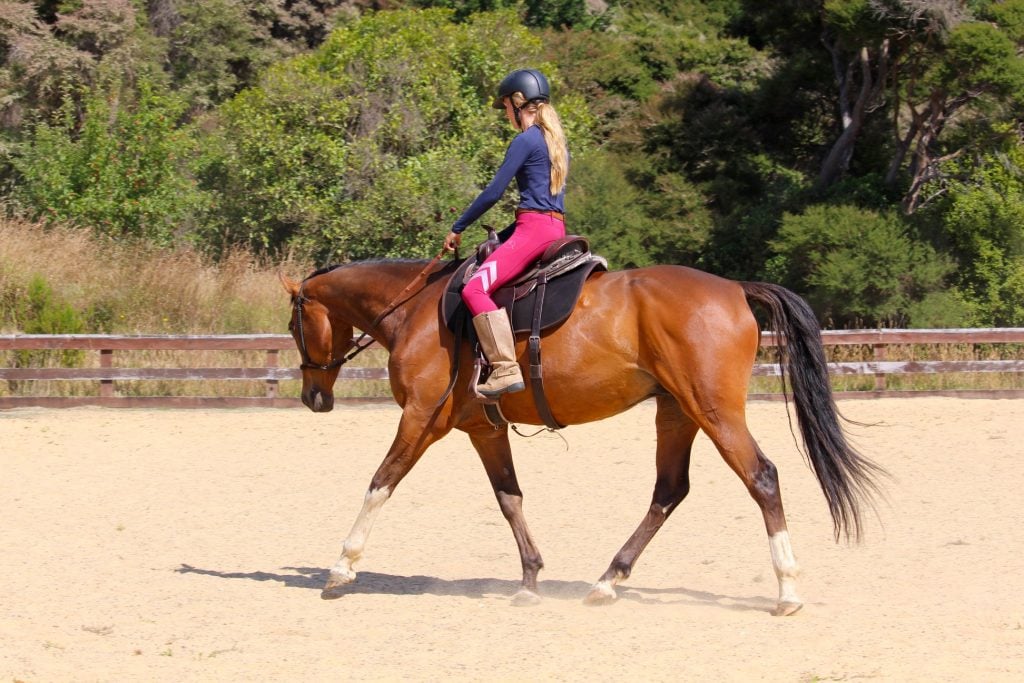
Yesterday, I was sitting on the mounting block in the middle of the arena deciding whether or not I would ride.

Truth be told, I was feeling kinda ick. My nerves were frayed around the edges- not from anything sinister, just too many late nights working which caught up with me that morning.

I had worked Dee in hand and on the ground and was musing whether or not to call it a day. The decision wasn’t stemming from any “can’t be bothered-ness” or “I don’t want to-ness” but genuine consideration about whether my headspace was such that I could bring my best self to the saddle.

Out of the blue, a voice popped into my head: What’s the best that can happen?

‘The best that can happen?’ I replied to myself, grinning slightly. ‘Don’t people usually ask what’s the worst that can happen?’

The thing was, a couple of weeks ago I’d felt a similar wave of bleurgh. Motivated by a clinic coming up that following weekend, I’d hauled ass out to the arena and jumped on for what turned out to be one of my best rides to date.

That ride now safely nestled in the success files of my brain, when the chips were down this day, it was there to remind me.

Not, what if everything goes wrong, but what if this is your sliding doors moment to your best ride to date?

And that, wonderful peoples, is what showing up does.

When you least expect it, it begins to ask, what’s the best that can happen?

And then you pull your hat on and ride.

Onwards.

❤️ Jane

Resistance & Acceptance

Resistance is a natural strengthening mechanism. The specifics of what and how it strengthens can work for and against you.
 
For instance, resistance combined with poor alignment places stress on areas of the body not designed to carry a load. If you lift a weight without paying attention to how you lift the weight, the resulting effort creates strain on the areas meant to be strengthened, and those designed to be targeted remain ineffectual.
 
The tendons and support muscles can be played like guitar strings, while those designed to bear weight remain weak.
 
In horses, if we seek a frame or body position that is not the product of healthy functioning and balance, increased resistance is often the method that’s resorted to. We tie this down, hold this in, use a stronger this, that or the other.
 
The body becomes segmented into front, middle and back. The under muscles strengthen when the goal is the topline. We sacrifice function for our skewed vision of form.
 
Emotional resistance works the same way. Anything we resist becomes stronger. Resist anxiety, fear, upset, anger or concern and it does not go away. Instead, the load is carried by the parts of ourselves not designed to deal with it and the messages become stronger, even if we refuse to listen.
 
I feel unwell. My stomach hurts. Why am I so tired?
 
What we resist strengthens. What we allow flows.
 
Resistance is necessary and welcome. It creates the crucial friction needed for strength, physically, mentally and spiritually.
 
It is, however, indiscriminate.
 
Physically, we must be specific with how and why we apply or use resistance, so it strengthens the areas capable of carrying the load.
 
Emotionally, we need to ensure that resistance doesn’t strengthen what in essence needs to be accepted, acknowledged and skillfully worked with in order that it be allowed to move through.
 
Onwards.
 
❤️ Jane

Remembering The Big Little Things

Going through the Brave Bucket Challenge has prompted me to post a reminder about the importance of Big Little Things.
 
Case and point:
 
It can be a split-second ride between feeling kind of stoked with yourself and then feeling embarrassed that THAT is the thing you feel stoked with yourself about. The conversation in your head might go something like this:
 
Oh yay! Me and TimeBomb just trotted, whoot! But it was only a trot. I can’t believe that’s all we are doing. Trotting. That something that simple is something that I thought about celebrating for a moment. Is this what I’m reduced to? Everyone else out there is qualifying for the Olympics and I’m having a good day if we manage to get the trot going? Sheesh. I need to get a grip and get some perspective.
 
You are correct, you DO need to get perspective. Celebrating where it is you are on your journey with your horse is not something to be ashamed or embarrassed about. It may not be where you want to end your final chapter, but that doesn’t mean that where you are isn’t completely valid and worthy of celebration.
 
We become our own joy-stealers when we refuse to acknowledge the good in what’s happening and prevent ourselves from creating momentum behind better feeling and experience.
 
You celebrating your Big Little Things gives others permission to do the same.
 
And hopefully, the day is not too far away when we realise that the whole dash gone lot was really just a linked chain of Big Little Things anyway that we’d grouped together in our mind as that one big thing we call life.
 
Onwards.
 
❤️ Jane
 

Are you ruled by the mood of the moment?

Oh yes, the old mood of the moment. How many of us have set a goal or an intention to work with our horses towards a specific end only to wake up the next day and well, not really feel like it? The lure of “I’ll do it tomorrow” is ever-present and at times, very appealing, especially when it comes to establishing new habits or patterns of behavior.

Tomorrow is a far more attractive time to start!

The thing about commitment is this: when you make one, you do so from a place of positive possibility. That place understands the higher vision or dream that you have for yourself and your horse and the processes and practices necessary to engage in to get you there. The inspired, energetic zone that we allow ourselves to imagine from is real but will only endure for as long as you actively seek it out. The natural stream of energy means that motivation will naturally peak, ebb and ease. With this knowledge in mind, it’s important to honor the mood of the moment, while simultaneously being connected to the higher vision.

This is where it gets tricky (hello emotional agility!).

Honoring the mood of the moment means staying responsive to what’s presenting and leaning into it. Leaning in does not mean succumbing (not all the time anyway), but instead acknowledging and understanding the motivating question behind the emotion that you are feeling and taking action in such a way that allows you to maintain emotional flow.

It’s possible to respect and have reverence for what you feel in the moment and still act in alignment with your higher intention.

Take Tuesday for instance. I recognized that I didn’t really feel like riding. I didn’t beat myself up about it or pretend it was any different. But I did ask, what’s this all about?

The truth of it was, I was working on some new stuff, and was concerned about my ability to do a good job with it when training on my own. That fear of not potential not-good-enoughness made me defer to the easier-to-handle thought that I just wasn’t in the mood.

Leaning into the thought allowed me to recognize that and act in accordance with what I ultimately knew was important to me: to show up and ride.

Attention to the moment, action in alignment with the higher intention.

Honor the mood of the moment. Consider it and what’s behind it. Check back in with the higher vision of where you want to take things.

Onwards.

❤️ Jane

The Level of Tension Prior Determines The Level of Tension After

When I was thinking about what to write this morning, I glanced down at my notes and saw the words ‘the level of tension after is directly related to the level of tension prior’. This, in turn, reminded me of another phrase which trots along with me in my mental library of helpful sayings and that is, add power to tension and you just get more tension.
 
Ain’t that the truth.
 
Earlier in the week, I wrote about embracing power and forward when riding, but within that, there are two very distinct categories that are important to pay attention to:
 
1. Power and forward with relaxation
2. Power and forward without relaxation
 
The feeling of the first is sublime. The feeling of the second not so much.
 
Adding energy to any sort of resistance only magnifies the resistance. If you are riding and feel imbalance, brace or tension, asking for “more” within that only magnifies what you are already experiencing.
 
I love how this principle directly correlates to navigating our own internal resistance. If you feel anxious or afraid, asking for more in that moment only causes the feelings to intensify.
 
Instead, we need to look at our beginnings. Is the start point we are transitioning from relaxed?
 
Taking time at the start allows for what follows to have a strong foundation.
 
If we feel the rise of tension, how can we return to balance?
 
Adding power increases the resistance. Resetting, rebalancing, repositioning allows for harmony to be restored.
 
Dropping back in order to be able to accelerate forward.
 
How can I begin from a place of relaxation?
 
And:
 
How do I return to it when it is lost?
 
Onwards.
 
❤️ Jane

On Embracing The Power & The Forward

“You have gaits, use them! There is nothing more frustrating for the horse than being held back from expressing his natural gaits”

Driving back from an appointment in town yesterday afternoon seemed like an unlikely time to have one of those “moments”, but nonetheless, I did. All of the sudden, in my mind’s eye, I transported myself to 20 years’ time, when Dee and I (good fortune prevailing) would be in the twilight years of our time together.

I pictured myself thinking how lucky I was to have had such a wonderful horse and the things that I had been grateful for. How I wanted to do it over again. And I realized, at that moment, that the position that I was sitting in now was the one that I would no doubt yearn to be in later. That right now, I was in the creative part of the story, rather than the reflective one.

I’ve always considered myself to be all in, but at that moment, I reaffirmed my commitment to get out of my own way and enjoy myself with my horse. In my lesson on the weekend, one of the quotes that stuck out in my mind (a paraphrase of a quote directed to my instructor Susie Walker from Phillipe Karl) was:

“You have gaits, use them! There is nothing more frustrating for the horse than being held back from expressing his natural gaits”

Often, in our own self-protection, we shut down our horse’s free-flowing forward and only allow them to demonstrate a limited version of what’s possible. I believe, metaphorically speaking, we do this to ourselves also.

My resolve was to no longer participate in this shutdown. To embrace the forward and to practice moving with the flow, instead of resisting it or suppressing it for some illusory form of control.

In physical terms, that means encouraging and acclimatizing to the power my horse naturally shows. To getting out and about and adventuring.

In emotional terms, it means acknowledging the internal resistance that comes up but allowing its edges to soften. Not giving it more power than my desire for its counterpart.

We have gaits. Best we be using them.

Onwards (and forwards!)

❤️ Jane

Comfort Zones: When To Stay & When To Wrap It Up

I had a question pop up on Instagram yesterday that I thought would be a great one to chatter about, simply because it’s something that will be really familiar to many of us. It came in response to the latest podcast episode on comfort zones, where I talk about some of the common pitfalls that come up and the resistance that we experience whenever we look to extend the outer edges of our own.

Here’s a snippet from the question to get us started:

“It was good to hear you talk about this so I don’t feel like such a failure! I find I’m continually butting up against and going over my comfort zone, and sometimes it’s hard to know how long to stay there because usually I immediately go ‘oh, I need to finish now before something bad happens and I have to force myself to continue just a little bit more so I’m not continually stopping the minute that feeling comes up. Is that the right thing to do?”

So, when to stay and when to wrap it up?

In my experience, this not so much a logical or analytical decision as it is a somatic and intuitive one. The base understanding is that any movement outside our comfort zone is going to result in feelings of unease. In order to establish a new normal where extension of our knowledge and self is part of the course, we need to be intentionally seeking out areas of low skill and ineptitude and actively drawing that into the training process, if only for bite-sized chunks of time.

The movement to the zone just beyond your comfort zone is often referred to as the Sweet Spot. The sweet spot is where 50 % of the time, you feel like you can easily complete the task at hand, and 50 % of the time, it feels like it’s just out of your reach. The metaphor that I use is trying to remember a word and not being able to think of it in the moment. You’re searching for it, it can feel frustrating and just beyond your grasp, but it’s not anything that’s going to send you into a full-blown panic (that’s the survival zone, the next step over, and one that I don’t encourage hanging out in!).

The differential between understanding whether we are acting on an old pattern of behavior or responding in a way that is true for the moment is one that we need to feel our way through, and for those of us who have become reliant on the overthinking mind, this can feel like an untrustworthy process.

How do we tell the difference? Old patterns and behaviors are familiar. It’s the feeling of “here we go again”. When we are in that place, we can recognize the experience as an upward cycle of progress and open ourselves up to the possibility of creating a new pattern. If a well-practiced exit strategy arises when you are expanding your comfort zone (and provided it is safe to do so), then stay for a minute beyond what you would like to. If you are able, detach from the story and instead, zero in on the feeling until you notice a shift in its quality.

This is a practice of stepping out of a pattern and staying in your direct experience.

Naturally, there are times also when choosing to opt-out is the intelligent thing to do and I believe that we know in our gut whether or not this is the case. These are the situations where you feel you are unequipped to deal with what might present, in which case, you have valuable information about how to equip yourself in order to successfully negotiate a similar situation in the future.

It comes back again to the question:

Is what I am feeling true for the moment?

And acting in alignment with that.

Onwards.

❤️ Jane

If you’re keen to check out the podcast I mentioned, click here to listen in! 

What If…

What if this is all part of it?
 
What if the heartbreak is necessary
 
The putting off a part of it
 
The wrong turn a meant for one
 
What if we were to
 
Let go of our well-practiced delays and instead
 
Think
 
What if the bravest step was the simplest and the closest?
 
The pulling on the boots.
 
The making our way out to the paddock.
 
The reaching out for help.
 
The letting go of eventual arrivals to be in the place we find ourselves in.
 
What if it’s all part of the ritual?
 
What if we let go of the idea that is was meant to be any different
 
And understand that any lack of appreciation
 
Might simply mean that we aren’t paying attention.
 
? Jane

Showing Up Is Your EveryDay SuperPower

Here’s the thing…

We can never guarantee the outcome of anything.

We can’t even be sure that the time we do put in is going to yield positive results.

That’s not just true of our horsing life. It’s true of life full stop.

Many of us try to do or achieve more by packing more into a day, hour, minute, but despite that, there’s an epidemic of dissatisfaction because we either aren’t taking the time to do the things that are really important to us or we are just not doing what we say we will.

Being ProcrastoBusy is a great example of this: Filling your day up with stuff to avoid doing things that are important to you but you are putting off for one reason or another.

Being unintentional with your time: Getting busy being busy and then looking back at the end of the week and wondering what you actually did that felt like it contributed to life in a meaningful way.

Which leads me back to the SuperPower of Showing Up.

I know that every time I get on to ride that I’m not guaranteed a “great ride”.

I know that today might not be the day where we the things that I aspire to come together, or where I have a creative solution to a challenge, or that I feel confident or brave without having to think about it.

What I DO know is that if I don’t put myself in a position to make that happen- be that in the arena, on the trail, in the yards, at my desk watch that training video- then the only thing I DO guarantee is that it’s not going to happen.

Showing up creates the conditions for learning, growth, and progress to occur.

NOT showing up will leave you stuck with an aspiration or desire in your head, but not in your lived experience

Which is why, once again… showing up is your everyday superpower.

Onwards.

❤️ Jane

Evaluation & Reflection: Remaining Entirely Self-Focused

How’s this for something to practice?

When it comes to evaluating or reflecting on a training session, it’s easy to become outwardly focused.

“My horse did this…”

“They said this and it caused me to do this….”

“This happened because of this situation/person/scenario and as a consequence, I had no choice but to do ‘x’”

For the next 24 hours, see if you can evaluate any training sessions or interactions that you have with your horse and remain entirely self-focused throughout.

⭐️ An outward-focused example:

Most of the ride was ok, but he spooked at something unknown in the bushes down the far end of the arena and for the rest of the session, we worked on emptying out the tension.

He was a bit behind my leg too- it felt like he was sucking back when I was asking him to go forward- and he definitely had a tendency to drop his shoulder when we were going to the right.

⭐️ A self-focused example:

I needed to be more aware of where I was holding tension and to make sure that any tension he was holding wasn’t originating from or being mirrored in my own body.

At times, I let me focus get ahead of me and I became more concerned about what was concerning him, rather than focusing on what I could do to facilitate relaxation.

Overall, I’m going to practice doing less and seeing if that decreases the resistance to forward and make sure I’m evenly placed in the saddle to encourage that straightness in him also.

Being self-focused brings your attention back to your ultimate point of influence: yourself. It also ensures that you are operating from a place of full responsibility and with enough discernment to understand that you are always a primary agent in the equation.

Onwards.

❤️ Jane

Can We Start The Day Again?

Yesterday was the first day back at school for Team Pike. I feel like we started strong. 50% of required participants were out of bed in good time, and the remaining 50% rustled enough to show adequate signs of life.

By 7:45 am, I still had a solid eye on the mother of the year crown. I mean, I had baked the night before (I know!) and made a lunch that was practically goor-met.

Giles and I made the decision between us to split rank. He would take Tommy to kindy, and I would take Flynn to school. This would allow for books to be collected and new classrooms to be found and settled into without having to complete aforementioned activities whilst being poked in the eyeballs and told knock knock jokes that inevitably have “poo” somewhere in the punchline on repeat dial.

After settling into separate cars, I nod smugly to myself. This is in the bag, I think, having completed the hardest leg of the activity- moving from the house to the car.

Driving up the hill, however, things start to feel not quite right. The car starts doing tiny lurches, similar to how I imagine a mechanical bull feels when it’s operating on only ten percent battery.

We make our way to the top of the hill before deciding that things are a bit off, and I pull over. Giles, who is behind us, pulls in also.

The decision is made to amalgamate. I attempt to not feel very irritated by said car-what-is-not-supposed-to-be-a-mechanical-bull and act like a carefree, easygoing Mumma whilst secretly wanting to show it (the car that is) who’s boss by ripping off a mud guard and throwing it into the neighbouring paddock.

Settling into my new driver’s seat, we begin again, now with two kids in the car. I think, we still have time, we’ve got this, and turn on the radio. A further five minutes down the road, Flynn turns to me and says, I left my bag at home.

Because I am carefree, I squeak out, no worries! And we turn tail and head home.

Bag collected, we turn again, now 15 minutes late for the first day of school.

Knock knock, Tommy says loudly from the back.

Arriving at school, I pick up a drink bottle whose lid is not on properly and it explodes down the front of me. Because I am carefree and I have baked, I smooth down my sodden front, pick up smaller child who shrilly declares “eww, you’re wet!” and escort eldest child to his new classroom.

Some 30 minutes late for the first day of school.

On the way home, I text Giles.

Can we start the day again please?

Starting the day again is a bit of a family institution. If things go pear-shaped, or the car turns into a mechanical bull, we simply start the day again.

I’ve used it in the middle of rides, where I have felt myself losing my centre. I stop, regroup, and start the ride again.

It’s all too easy to let the energy of a moment (or many moments) drag through the entire day and pollute the waters unnecessarily. Starting the day, the ride, or the moment again is a very simple and yet profound resolution to draw a line in the sand and realise that you always have the choice to stop, take a breath, and start the day again.

You can always start the day again.

Onwards.

❤️Jane

Time Spent or Time Invested?

Time spent or time invested? How do you look at it?

If we think of our time with our horses as being spent, we are operating from a loss framework, where time in means time gone.

If you’ve ever exclaimed, ‘I’ve been out here for an hour already and it’s still not working!’

… then this is the dance you’re jiving to.

Expectations, time delineated results and instant gratification all live under this umbrella.

Time invested, on the other hand, recognises that partnership arises off the back of compounded experience. I may not see the product of my hours invested immediately- or even after many weeks or months- but I understand that how I show up and how often I show up are placing cumulative deposits in the relationship bank, and with enough commitment, the fruits of that investment will make itself known to me.

Invested or spent?

Which perspective are you choosing?

❤️ Jane

Wellness First…

Want to know a little mantra that I’ve been using this year that has really turned things around for me?

Wellness first.

The idea of putting your wellness first has made everything in my life better. Towards the end of last year, I realized that I was feeling totally strung out.

I was physically sore.

I was tired.

I felt a loss of groundedness and centeredness that I know is so important to maintain.

The other thing I noticed?

It’s very easy to martyr yourself to the system. I could reel of a number of easily supported and legitimate excuses for why I felt that way…

… I was super busy with work

… I was super busy with family

… I had lots of things going on that demanded my attention

…but the reality is, I had yet to take full responsibility for myself and claim the time that I needed to make showing up for life in a wholehearted way sustainable.

I looked at what my body needed and came up with three practices that make everything better.

Getting enough sleep.

Drinking enough water.

Doing daily yoga.

So far this year, I’ve made them non-negotiable. I still notice times where I’m tempted to do “this bit of work” or “stay up this bit later to do this”. But I also know that the compound effects of that are disabling.

So if you are feeling me, I encourage you to do the same.

What do you need?

And,

Wellness first.

It’s better for everyone.

❤️Jane

Falling In & Out of Good Habits

You’ve probably heard me talk before about the life changing magic of simply showing up, and why it’s so important when it comes to creating momentum and building your courage muscles.

The other reason that showing up is so important?

To prevent the all or nothing cycle that is so easy to fall into when we feel ourselves having an off day. This cycle is pretty much the hallmark of the New Year’s Resolution, or indeed any habit or commitment that we make for ourselves that starts off with an initial flush of enthusiasm and ends with us realising that we’ve actually been scrolling Facebook for the last hour and what the hell and how did that happen.

And before any smugness sets in for those of us with well-established routines of showing up, falling out of a good habit or finding yourself unable to show up in the way you want to because of well, life (it happens to the best of us), is something that we need to be mindful of every step of the way.

For instance, the way I’ve engineered things means that I work with my horses every morning of the weekdays. It used to be that weekends provided reliable riding times, but now my boys are older, it’s much more about them than it is about me. For the most part, this habit is effortless. But there are times when I’m tired, or I have a lot of work to do, or something comes up where showing up to play together with my horse is not possible. The rules I play too is that it’s what you do most of the time that matters- one day is ok, but I don’t want one day to have a snowball effect. Consequently, I never let myself be totally absent more than a day. Even if on the second day it’s not possible for me to show up physically, I do something to keep my head in the game. Watch a training video. Read a book. Anything that mentally takes me into the learning and showing up space.

The reason? It’s as much about maintaining the sense of being a person that gets out there and shows up for their horse as it is putting in the hours. In fact, “putting in the hours” is never a framework I operate from; but despite the passion, enthusiasm and love I feel for my horses, life can pull us away if we are not intentional about maintaining what we love.

So when it doubt, keep showing up. For yourself as much as for anyone or anything else.

Onwards.

❤️ Jane

Are The Feelings You’re Having Your Own?

We’ve touched on a few contributing aspects related to anxiety the last few days, but I wanted to throw another into the mix that is perhaps the least considered and even less so understood; anxiety (or feeling generally) that is absorbed or taken on from something or someone around us.

This tendency to “catch” emotions is officially referred to as emotional contagion, and there are various explanations offered as to why this occurs. For the purposes of this (very brief) discussion, however, I want to talk about it from the context of what I refer to as “unaware or unskilled sensitivity”, where we act as an emotional sponge and become easily overwhelmed or disabled by the emotions of others, including our horses.

It’s my experience that many of us are actually afraid and avoidant of emotions, especially emotions that we consider to be difficult or uncomfortable. This arises, in part, because we aren’t skilled firstly, in understanding the motivating questions behind emotions and what they are communicating, and secondly because we have become disconnected from our own bodies to the extent where emotions no longer act as clear communicators, but form a swirling pool of feeling that is difficult to make sense of. Our tendency to suppress or deny emotion comes mainly, then, because we have no clue how to skilfully deal with what it is we’re experiencing.

Skilled sensitivity involves being aware of and able to identify emotions and feelings as they exist in yourself and others. The accuracy with which we do so depends on how aware you are of your own internal state and how proficient you are at acknowledging and regulating feeling.

Trusting how we feel becomes all the more important when partnering with horses. With humans, we can ask for confirmation of the accuracy of what it is we are sensing; this is obviously not possible with our horses. How then do we go about developing this understanding between us?

By acknowledging and noticing how it is you feel.

How you feel in your body is always trustworthy; it communicates the reality of what’s present in the moment. The next stage is infinitely more difficult; separating out what is yours and what is theirs; being able to identify what is being felt and allow for it; developing an emotional vocabulary that allows us to artfully deal with what presents instead of being at the mercy of it.

Skills that are built moment by moment through practice, awareness and interaction.

Onwards.

❤️Jane

Untangling Anxiety

Yesterday, we talked about anticipation anxiety and the delicate process of untangling the experience of it with the necessary next steps to move through it. The question was asked, what if my anxiety comes from the past, from an accident? To dive into this a little deeper, I want to break it down into a couple of different parts.

First up, what you feel is always true for you, but it is not always true for the moment. The differential I am always seeking to understand is:

Is this emotion true for the moment, or is it connected to a past experience or story that is making itself known in my present?

In emotions that are true for the moment, the feeling rises up in response to our experience. In order to stay in flow with it, we are then required to understand the motivating question behind it in order that we take action in alignment with it (or choose not to act as the case may be), and in doing so, the emotion understands it has been heard; we are in flow with our experience and move onto the next thing.

In the case of the latter, here we find ourselves in the midst of an experience, and anxiety (for example) rises to the surface. In this case, we can appreciate that our reaction to what’s presenting is not true for the moment. A basic example of this would be standing in the arena with a relaxed horse in front of you and being overwhelmed by concern.

Is the anxiety real? Yes. It is real for you.

Is it real for the moment? No.

What you are experiencing in this moment is the residual effect of a past trauma making itself known in the present. A “glitch” in the nervous system which, given the right triggers, repeats on a loop until the tools are presented to provide it with a corrective emotional experience that sees harmony restored.

This restoration of harmony feels impossible, but it’s not. But it does require being gentle with yourself and developing the ability to recognize that in the midst of difficult experience, there is so much more that is available to you.

Understanding the difference between the two is the key to developing emotional flow.

Onwards.

❤️Jane

Trepidation & Anticipation Anxiety

Anxiety is such a curious experience, especially when it’s felt in anticipation. The curious part about it is that the trepidation is often felt in relation to something that we want; our desire to create something or follow through on something with our horses gets mixed up in concern, worry or unsureness and any joy that might have been simultaneously present gets sucked out in a matter of seconds.

Anticipation anxiety is an important thing to learn to manage simply because of its inevitability. If you are ever planning to push your comfort zone, step up to that next level or do something that’s important to you, then chances are you are going to feel a little or a lot of it at some point.

We are, after all, creatures of the imminent arrival. Being on a journey of any sort involves a series of anticipated arrivals at various micro destinations along the way, so it goes without saying; if we plan to journey, we already have in our heads an anticipated destination point that we wish to land in at a future place.

What happens will be something like this: something is coming. You might be riding at a lesson, doing something with your horse that causes you concern, about to be a part of a competition. And you find yourself feeling…. anxious.

Many times, the message behind anxiety is confusing.

Huh, you tell yourself. I’m not sure this is worth it.

And so in the midst of your anxiety, maybe you decide to not do it or to modify your efforts in some way that downgrades the experience.

Two things to remember: anxiety at its essence is a call for preparation.

And:

Anticipation anxiety is strengthened by a lack of follow-through.

The trajectory is this (overly simplified):

You feel anxious >> the concern builds >> you decide not to do the thing you want to do

In your mind, your anxiety says, I knew it! I knew there was something to be concerned about!

And the cycled is strengthened for next time.

There is no shame in anxiety. And there is no shame in deciding that for the moment, it’s all too much.

But understanding how it works and what your mind will tell you in the midst of it goes a long way to empowering yourself to navigate through it, and perhaps most importantly, to recognize you are not alone.

Anticipation anxiety is yet another expression of humanness.

Onwards.

❤️ Jane